The Construction Industry Scheme is where most contractors and subcontractors lose money or fall foul of HMRC, usually because the rates, deadlines and reliefs are never explained plainly in one place. You get deductions taken from your invoices, you file monthly returns under threat of penalty, and you hear about gross payment status, but nobody tells you whether you qualify or how much it would actually save you. The rules are scattered across gov.uk pages, accountancy jargon and outdated forum threads.
This guide fixes that by walking you through the correct CIS deduction rates, how monthly returns and deadlines work, how gross payment status can transform your cash flow, how to get worker status right, and what the April 2026 Making Tax Digital changes mean something for subcontractors. You will also learn why construction tax works differently, what triggers a verification check, and how to avoid the mistakes that cost you time and money.
Whether you are a main contractor managing dozens of subbies or a sole trader working under CIS for the first time, this is the only guide you need to stay compliant and keep more of what you earn in 2026.
The Construction Industry Scheme (CIS) Explained

(For Illustrative Purposes Only)
The Construction Industry Scheme requires contractors to deduct tax from subcontractor payments and send it directly to HMRC. Understanding how the verification process works, which deduction rate applies, and when to submit your monthly returns will help you stay compliant and avoid penalties.
How CIS works for contractors and subcontractors
Contractors must register for CIS if they pay subcontractors for construction work. Before making any payment, you need to verify each subcontractor with HMRC using their Unique Taxpayer Reference (UTR) or National Insurance number through the Government Gateway. This verification tells you which deduction rate to apply.
The scheme applies only to the labour element of invoices, not materials. Subcontractors should separate materials from labour on their invoices. For example, if a job costs £1,000 with £400 in materials and £600 in labour, CIS deductions apply only to the £600 labour portion.
Contractors submit monthly returns showing all payments made to subcontractors. These returns must reach HMRC by the 19th of each month following the tax month end. The tax month runs from the 6th of one month to the 5th of the next.
CIS deduction rates (20%, 30% and 0%)
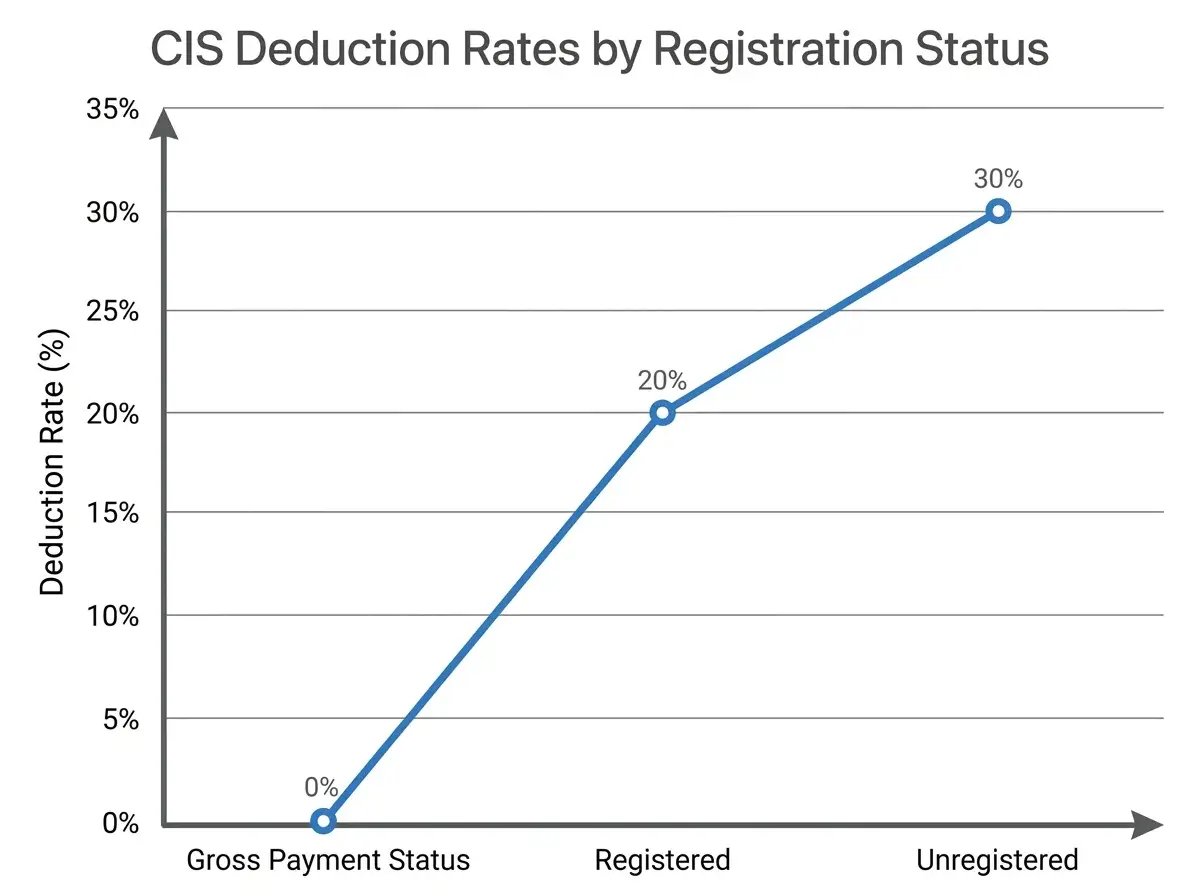
HMRC’s verification procedures determine which rate applies to each subcontractor. The rate depends on the subcontractor’s registration status and whether they qualify for gross payment status.
| Subcontractor Status | Deduction Rate | Requirements |
|---|---|---|
| Registered | 20% | Registered with HMRC for CIS |
| Unregistered | 30% | Not registered with HMRC for CIS |
| Gross Payment Status | 0% | Met HMRC’s compliance and turnover tests |
Registered subcontractors must have completed CIS registration with a valid UTR before the contractor verifies them. Those who fail to register face the higher 30% rate. Gross payment status allows you to receive full payment without deductions, but you must still report the income and pay tax through self-assessment or your company accounts.
Verifying subcontractors with HMRC

(For Illustrative Purposes Only)
You must verify every subcontractor before making the first payment using HMRC’s CISR (CIS online) service. Log in through your Government Gateway account with your CIS user ID and password. Enter the subcontractor’s details, including their UTR or National Insurance number, plus their company registration number if they operate as a limited company.
HMRC responds immediately with the correct deduction rate to apply. Keep records of all verification procedures for at least three years. If you make a payment before verifying, you must deduct tax at the 30% rate.
Re-verification is not usually required for ongoing relationships, but you should verify again if a subcontractor’s circumstances change or if they provide new registration details.
Monthly CIS returns and the 19th deadline
(For Illustrative Purposes Only)
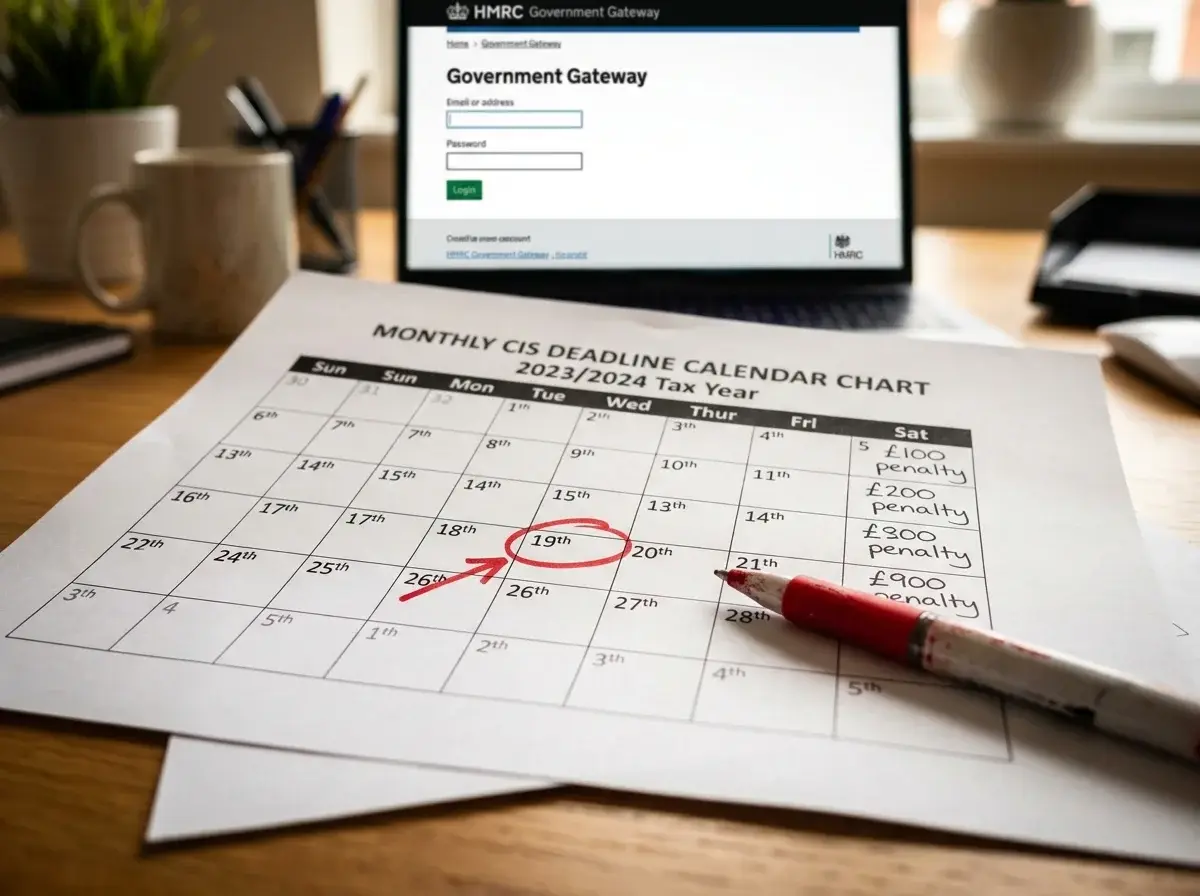
Submit your CIS return by the 19th of each month through the CISR online service. The return covers all payments made to subcontractors during the previous tax month. Even if you made no payments, you must file a nil return.
Late filing triggers automatic penalties. You face a £100 penalty if your return is one day late. After two months, you face an additional £200 penalty. If the return is six months late, you face a further penalty of 5% of the CIS deductions on the return, or £300 (whichever is greater). If it reaches twelve months late, you face another penalty of 5% of the CIS deductions, or £300 (whichever is greater).
Subcontractors reclaim deductions through different routes. Sole traders claim back overpaid deductions through their self-assessment tax return. Limited companies offset CIS deductions against their PAYE and CIS liabilities using the Employer Payment Summary (EPS).
Businesses outside construction become deemed contractors if their construction spend exceeds £3 million over any rolling twelve-month period. This means they must follow all CIS rules despite not being construction firms themselves.
CIS Return Deadline: Every Filing Date for 2026/27
The CIS return deadline is the 19th of every month, and it never moves. Each tax month runs from the 6th of one month to the 5th of the next, and your return covering that period is due 14 days later. So payments made between 6 June and 5 July must reach HMRC by 19 July. That single date is your CIS filing deadline, whether you paid one subcontractor or forty, and it applies even in months where you paid nobody at all – a nil return is still mandatory.
Where contractors get caught out is confusing the CIS submission deadline with the payment deadline. They are two different dates. The return itself is due on the 19th. The money you deducted is due on the 22nd if you pay electronically or on the 19th if you pay by cheque. Miss either and HMRC’s automatic penalty system starts on the 20th without warning or reminder.
One more thing worth knowing: HMRC does not extend the CIS deadline when the 19th falls on a Saturday, Sunday or bank holiday. The online service runs 24/7, so the date stands. Electronic payments are the exception; if the 22nd falls on a weekend, cleared funds must reach HMRC by the last working day before.
CIS Deadline Table: July 2026 to July 2027
| Tax Month (payments made) | CIS Return Deadline | Electronic Payment Deadline |
|---|---|---|
| 6 Jun – 5 Jul 2026 | 19 Jul 2026 (Sun) | 22 Jul 2026 (Wed) |
| 6 Jul – 5 Aug 2026 | 19 Aug 2026 (Wed) | 21 Aug 2026 (Fri)* |
| 6 Aug – 5 Sep 2026 | 19 Sep 2026 (Sat) | 22 Sep 2026 (Tue) |
| 6 Sep – 5 Oct 2026 | 19 Oct 2026 (Mon) | 22 Oct 2026 (Thu) |
| 6 Oct – 5 Nov 2026 | 19 Nov 2026 (Thu) | 20 Nov 2026 (Fri)* |
| 6 Nov – 5 Dec 2026 | 19 Dec 2026 (Sat) | 22 Dec 2026 (Tue) |
| 6 Dec – 5 Jan 2027 | 19 Jan 2027 (Tue) | 22 Jan 2027 (Fri) |
| 6 Jan – 5 Feb 2027 | 19 Feb 2027 (Fri) | 22 Feb 2027 (Mon) |
| 6 Feb – 5 Mar 2027 | 19 Mar 2027 (Fri) | 22 Mar 2027 (Mon) |
| 6 Mar – 5 Apr 2027 | 19 Apr 2027 (Mon) | 22 Apr 2027 (Thu) |
| 6 Apr – 5 May 2027 | 19 May 2027 (Wed) | 21 May 2027 (Fri)* |
| 6 May – 5 Jun 2027 | 19 Jun 2027 (Sat) | 22 Jun 2027 (Tue) |
| 6 Jun – 5 Jul 2027 | 19 Jul 2027 (Mon) | 22 Jul 2027 (Thu) |
Why Construction Tax Works Differently for Subcontractors

(For Illustrative Purposes Only)
Under the Construction Industry Scheme, contractors deduct tax from your payments before you receive them, which means you deal with cash flow pressure that most other self-employed workers don’t face. Unlike plumbers or electricians working outside construction, you pay tax upfront rather than settling your bill later through self-assessment.
Tax is deducted before you get paid
When a contractor pays you for construction work, they deduct either 20% or 30% from your invoice and send it directly to HMRC. The rate depends on whether you’re registered with CIS. Registered subcontractors have 20% deducted, whilst unregistered subcontractors face a 30% deduction.
These deductions count as advance payments towards your tax and National Insurance bill. You don’t receive the full amount you invoiced. Instead, the contractor keeps back the CIS deduction and reports it to HMRC through monthly returns.
This system exists because HMRC wants to collect tax throughout the year rather than waiting for subcontractors to file Self Assessment returns. The scheme reduces tax avoidance in construction by making contractors responsible for deducting tax before payments leave their accounts.
The cash flow problem this creates
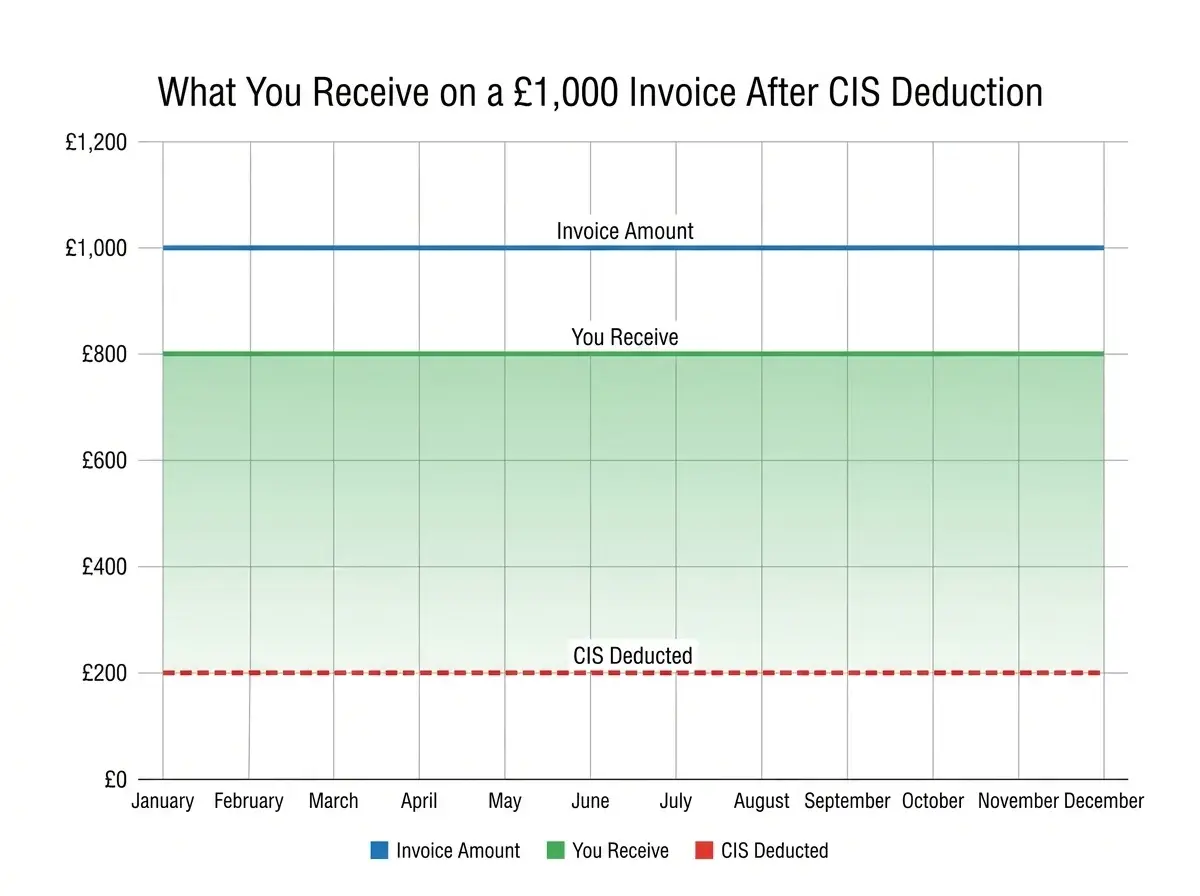
You need to price jobs carefully because you won’t receive your full invoice amount. If you quote £1,000 for a job, you’ll only receive £800 after the 20% CIS deduction.
Many subcontractors struggle with this reduced income, especially when starting. You still need to pay for materials, fuel, and other business costs from the reduced payment you receive. This is different from typical self-employed workers who receive full payment and set aside tax themselves.
Where CIS fits alongside VAT and self-assessment
CIS deductions don’t replace self-assessment. You still need to complete a tax return each year and calculate your actual tax bill. HMRC then credits the CIS deductions already taken from your payments against what you owe.
You’ll claim back overpaid tax if the deductions exceed your final bill. If the deductions don’t cover your full liability, you’ll need to pay the difference. Self-assessment also calculates your National Insurance contributions, which CIS deductions don’t cover.
VAT works separately from CIS. If you’re VAT registered, you charge VAT on top of your labour costs, and contractors shouldn’t deduct CIS from the VAT element of your invoices.
Gross Payment Status: The Cash Flow Upgrade

(For Illustrative Purposes Only)
Gross payment status lets you receive payments in full without any CIS deductions taken at source. This means you settle your tax through normal self-assessment returns instead of having contractors withhold money from every invoice.
What does ‘gross payment status’ mean
Under the Construction Industry Scheme, contractors normally deduct either 20% or 30% from subcontractor payments and send it to HMRC. With gross payment status, that deduction drops to 0%.
You get paid the full invoice amount. The tax you owe still needs to be paid, but you handle it directly through your tax return rather than having it withheld upfront.
For a subcontractor with a £200,000 annual turnover, the standard 20% rate means £40,000 held back throughout the year. Gross payment status keeps that £40,000 in your business. giving you complete control over when and how you pay your tax bill. It transforms your working capital position.
The three qualifying tests (business, turnover, and compliance)
HMRC requires you to pass three tests before granting gross payment status. All three must be satisfied at the time of application.
The business test checks that you genuinely operate within the construction industry. HMRC looks at your business structure, the work you carry out, and whether construction forms your primary activity.
The turnover test requires a net construction turnover of at least £30,000 per relevant person in 12 months. For companies, the threshold rises to £100,000 for the whole business. This must be business-to-business construction work, not retail or direct consumer sales.
The compliance test examines your tax record. You must have filed all returns on time and paid all tax, VAT, and National Insurance when due. HMRC checks your Self Assessment, Corporation Tax, VAT, and PAYE records. A single late payment or missing return can fail this test.
How to apply and how to keep it
You apply through your Government Gateway account using the CIS online service. You will need your UTR and details of your construction turnover for the qualifying period.
HMRC reviews applications within 60 days. Once granted, your status appears when contractors verify subcontractors through their verification procedures.
Your status is reviewed annually. You must maintain the same standards that earned you the status initially. Keep filing and paying everything on time, and maintain your turnover threshold.
Why HMRC can remove it
HMRC removes gross payment status if you fail compliance checks during annual reviews or spot audits. Late tax returns, missed payment deadlines, or falling below the turnover threshold all trigger removal.
Once removed, you return to standard deductions immediately. You must wait 12 months before reapplying, and during that period, you lose all cash flow advantages.
Monthly CIS Returns
Contractors must submit monthly returns to HMRC detailing all payments made to subcontractors and the tax deductions withheld. These returns are mandatory even if you haven’t paid any subcontractors during the month.
Filing Deadlines
You must submit your CIS monthly return by the 19th of each month following the tax month in which you paid subcontractors. The deadline is 19 days after the end of each tax month, which runs from the 6th of one month to the 5th of the next.
For example, if you pay subcontractors between 6 July and 5 August, you must file your return by 19 August. This applies regardless of whether you use paper or electronic filing methods.
HMRC requires you to submit a return even if you have not made any payments to subcontractors. You need to file a nil return to confirm no payments were made during that tax month. Missing this step can result in penalties even when no money changed hands.
Penalties for Late Submission
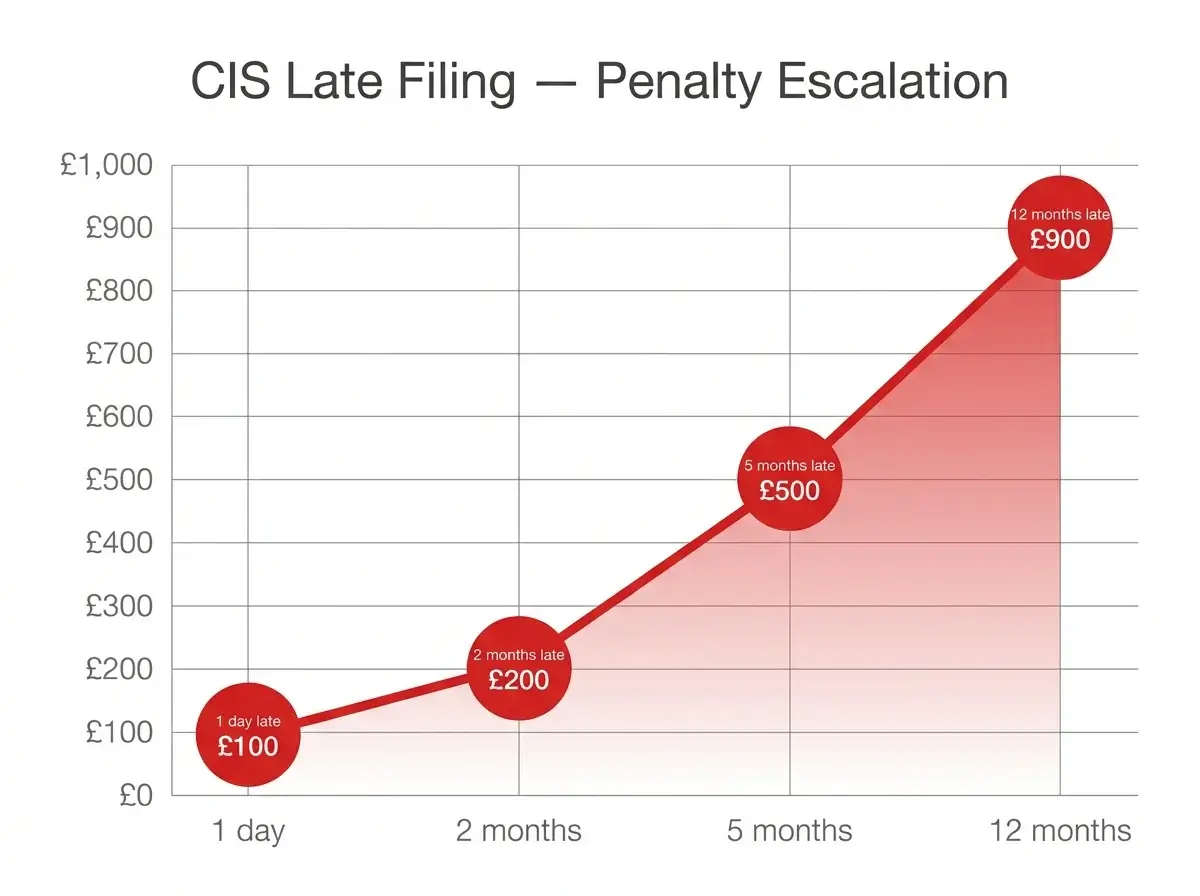
HMRC issues automatic penalties when you file your CIS returns late. The penalty starts at £100 for each month or part of a month that your return is overdue.
If you continue to miss the deadline, the penalties increase substantially. You’ll face an additional £200 penalty if your return is more than two months late. After six months, HMRC can charge further penalties or estimate the tax you owe and issue additional charges.
Late filing can also affect your subcontractors. They rely on accurate and timely returns to ensure their tax records remain correct with HMRC. Repeated late submissions may trigger compliance checks and increased scrutiny of your business operations.
CIS Deduction Rates
Contractors must deduct money from most subcontractor payments and send it to HMRC. The rate of deduction depends on whether the subcontractor is registered with CIS and their payment status.
Contractor Deduction Obligations
You must verify each subcontractor with HMRC before making any payments. This verification tells you which CIS deduction rate to apply.
When you pay a subcontractor, you deduct the appropriate percentage from their labour costs only. You do not make deductions from the cost of materials if the subcontractor buys them directly and includes them on their invoice separately.
You need to send these CIS deductions to HMRC by the 22nd of each month if you pay electronically. If you pay by cheque, the deadline is the 19th. You must also give your subcontractors a statement showing what you paid them and how much you deducted.
Keep detailed records of all payments and deductions. HMRC can fine you if you apply the wrong deduction rate or miss payment deadlines.
Subcontractor Deduction Rates
Your CIS deduction rate depends on your registration status with HMRC. There are three possible rates:
| Status | Deduction Rate | Description |
|---|---|---|
| Registered subcontractor | 20% | Standard rate for CIS-registered businesses |
| Unregistered subcontractor | 30% | Higher rate if you haven’t registered for CIS |
| Gross payment status | 0% CIS | No deductions if you meet strict conditions |
Most subcontractors pay the 20% rate after registering with CIS. If you haven’t registered, contractors must deduct 30% from your payments.
‘Gross payment status’ means you receive full payment with no deductions. You need to meet strict requirements, including passing tax compliance checks and proving most of your work is construction-related. HMRC reviews gross payment status regularly and can remove it if you don’t maintain the required standards.
Making Tax Digital for Income Tax
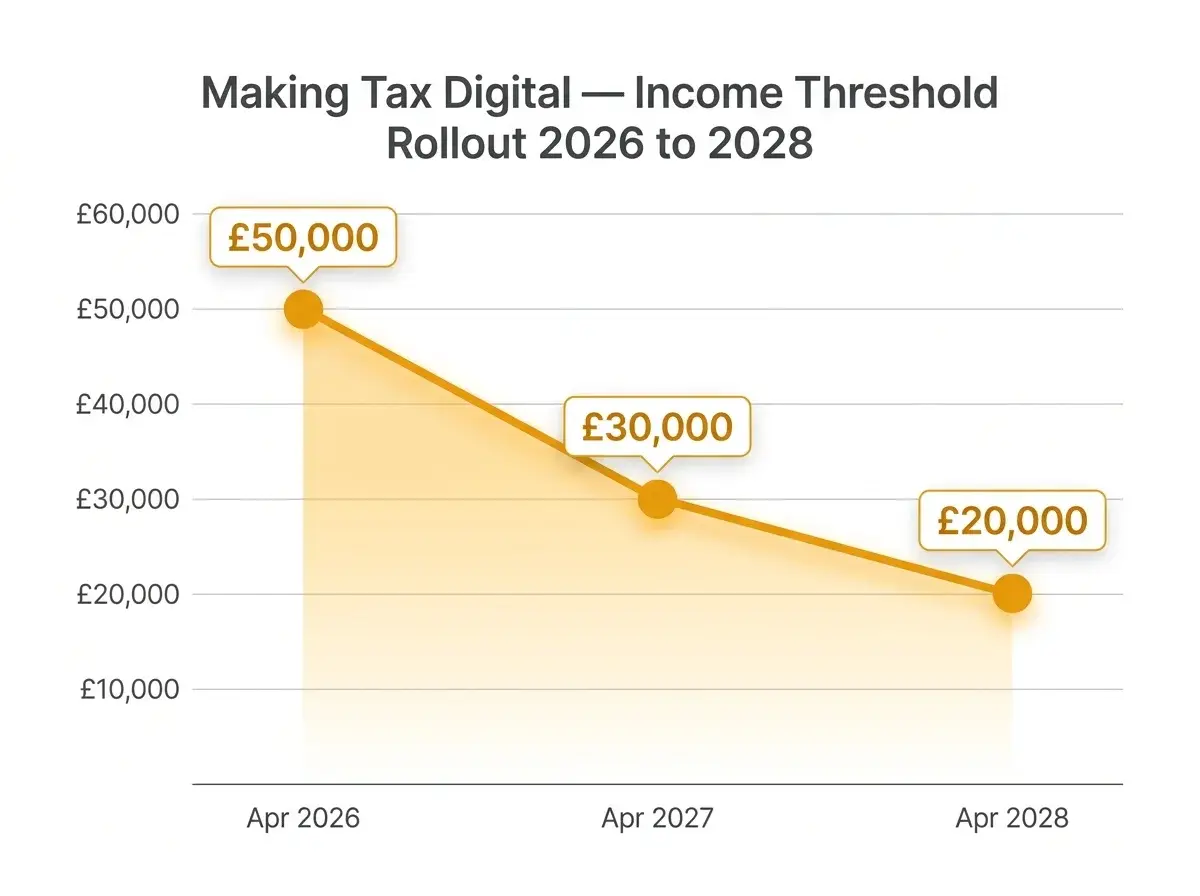
From April 2026, many CIS subcontractors must keep digital records and submit quarterly updates to HMRC. The start date depends on your gross qualifying income, and it’s crucial to understand that this figure includes the full amount you invoice before any CIS deductions.
The rollout timeline (£50,000, £30,000, £20,000)
(For Illustrative Purposes Only)
Making Tax Digital for Income Tax rolls out in three phases based on your qualifying income threshold. If your qualifying income exceeds £50,000 in the 2024/25 tax year, you must comply from 6 April 2026. The threshold drops to £30,000 from 6 April 2027 and finally to £20,000 from 6 April 2028.
These dates are mandatory. You cannot opt in early if your income falls below the threshold for your cohort.
HMRC will offer a penalty grace period for the first year (2026/27 tax year only). This means late quarterly submissions won’t trigger penalties during that initial year, though you should still aim to submit on time to avoid building bad habits.
Why qualifying income is gross, not what you take home
This is where many CIS subcontractors make a costly mistake. Your qualifying income is the gross amount you invoice, not what lands in your bank account after CIS deductions.
If you invoice £55,000 during the tax year but only receive £44,000 after the contractor deducts 20% CIS tax, your qualifying income is still £55,000. You fall within the April 2026 mandate, even though your actual take-home was below £50,000.
The payment and deduction statement you receive from contractors shows both figures. Always use the gross figure when working out whether MTD applies to you. Your CIS records should already track this information, as you need it for your self-assessment return.
Quarterly updates and the final declaration
MTD replaces the single annual self-assessment return with four quarterly updates plus a final declaration. You must use MTD-compatible software to submit these updates.
Each quarterly update covers three months of income and expenses. The deadlines are one month after each quarter ends. You then submit a final declaration by 31 January following the tax year, which finalises your tax position and claims any reliefs.
Your software links directly to HMRC’s systems. You can no longer submit paper returns or use the basic online portal if you’re within scope. Keep digital records of payments throughout the year to make quarterly reporting easier.
Does MTD apply if you run a limited company?
No. Making Tax Digital for income tax applies only to sole traders and partnerships filing self-assessment returns.
If you operate through a limited company, you pay corporation tax instead. MTD for Corporation Tax was scrapped by the government in July 2025, so limited companies continue using their existing filing methods.
This creates a key difference: CIS subcontractors trading as sole traders must follow MTD rules, whilst those operating through limited companies do not. Your business structure determines which system applies, regardless of whether you work under CIS.
How KG Business Services Ltd Supports Clients

(For Illustrative Purposes Only)
KG Business Services Ltd is a family-run accountancy firm with AAT and ACCA qualifications based at 71 Kilbowie Road, Clydebank. The firm works with contractors and subcontractors across Clydebank, Glasgow, and beyond, including clients in Dubai.
The team handles all aspects of CIS compliance for construction businesses. They help you register with HMRC as a contractor or subcontractor and complete your monthly CIS returns on time. They verify subcontractors before payments are made and assist with gross payment status applications if you qualify.
KG Business Services Ltd also reviews worker status to ensure you classify workers correctly under CIS rules. As Xero Gold Partners, they set up and support Making Tax Digital for Income Tax to keep your records accurate and compliant.
Contact the team today for a free consultation. Call 0141 737 0529 or enquire now to discuss how they can support your construction business with CIS and accountancy services. You can also read their companion guide on construction VAT and accounting for more information on managing your tax obligations.
Frequently Asked Questions
CIS involves specific deduction rates, registration steps, and rules around gross payment status. Subcontractors often wonder how deductions impact their tax bills and whether they can claim refunds. Contractors need clarity on verification and reporting duties under Making Tax Digital.
What percentage is CIS tax?
CIS deductions are either 20% for registered subcontractors or 30% for those not registered with HMRC. Subcontractors with gross payment status pay no deductions at all. The rate you face depends entirely on your registration status, so staying registered keeps more money in your pocket each month.
How do I apply for contractor registration and start verifying subcontractors?
You register as a CIS contractor through your HMRC online account or by calling the CIS helpline. Once registered, you verify each subcontractor before making the first payment to check their status and applicable deduction rate. HMRC provides the verification result immediately online or within two working days by phone.
What deduction rates apply, and when is 20% or 30% used instead of gross payment status?
Registered subcontractors have 20% deducted from their payments, whilst unregistered subcontractors face a 30% deduction. Gross payment status allows you to receive full payment with no deductions. To qualify for gross payment status, you must meet strict conditions around business tests, tax compliance, and turnover thresholds set by HMRC.
Do subcontractors have to pay deductions if they are self-employed, and how are these calculated?
Self-employed subcontractors must still have CIS deductions taken from their payments unless they hold gross payment status. Contractors calculate the deduction by applying the relevant rate (20% or 30%) to your labour costs, excluding VAT and materials. These deductions count as advance payments towards your income tax and national insurance.
How do deductions affect a subcontractor’s tax and National Insurance, and how are they reclaimed or offset?
CIS deductions go directly to HMRC and reduce what you owe when you complete your Self Assessment tax return. If your deductions exceed your actual tax and National Insurance bill, you can claim a CIS tax refund through your tax return. You offset the amounts on your return, and HMRC processes any CIS refund owed to you.
Does MTD for Income Tax apply to CIS subcontractors?
Making Tax Digital for Income Tax applies to self-employed subcontractors once their trading income exceeds £50,000 per year. You must then keep digital records and submit quarterly updates through compatible software. This requirement runs alongside your existing CIS obligations, so you still need to report deductions on your Self Assessment return annually.