
HMRC does not send reminders. It sends penalty notices, and most small business owners do not realise they have been fined until a letter lands on their doormat weeks after the deadline has passed.
RTI stands for Real Time Information, and it is how every UK employer reports payroll to HMRC. Every time you pay staff, HMRC expects to hear about it on or before that payday, not at the end of the month and definitely not at the end of the tax year.
This catches out new employers who assume payroll reporting works like a tax return, and it catches out established businesses who miss one submission during a busy month. Get familiar with what RTI submissions are, when they fall due, what triggers a fine, how much HMRC charges, and how to build a process that keeps you off their radar.
What Is Real-Time Information, and Why Did HMRC Introduce It?
Real-time information is the system that forces every employer to tell HMRC about pay and deductions on or before each payday, replacing a system where employers only had to report once a year. HMRC introduced RTI in 2013 because waiting twelve months for accurate PAYE data was slowing everything down, from tax code corrections to benefit calculations.
The Old System That Let Employers Report Once a Year
Before 2013, employers filed a P35 at the end of the tax year, along with a P14 for each employee. This end-of-year return told HMRC what tax and National Insurance had been deducted across the whole year, but not until months after the money had already changed hands.
HMRC had no visibility during the year. Errors piled up, tax codes went stale, and underpayments or overpayments only surfaced long after the fact.
How RTI Changed Payroll Reporting Overnight
RTI scrapped the annual catch-up and replaced it with electronic payroll submissions sent every payday. Employers now report income tax deductions, National Insurance, and other figures through HMRC online services in real time, giving HMRC a live picture of what every employer owes and what every employee has earned.
This shift means payroll compliance in the UK is now a rolling, ongoing task rather than a once-a-year form-filling exercise.
Who Has to File RTI Submissions
With extremely rare exceptions for digitally excluded employers (such as specific religious grounds), every employer with a PAYE scheme must file RTI submissions electronically. It does not matter if you employ one person part-time on minimum wage or run a payroll with hundreds of staff. Size, turnover, and employee count change nothing about the obligation itself. If you have registered for PAYE and you pay anyone, RTI applies to you from the first payday. If you are setting up payroll for the first time, it is worth reading through how to set up payroll for the first time before your first pay run goes anywhere near HMRC.
The Two RTI Submissions Every Employer Must Know
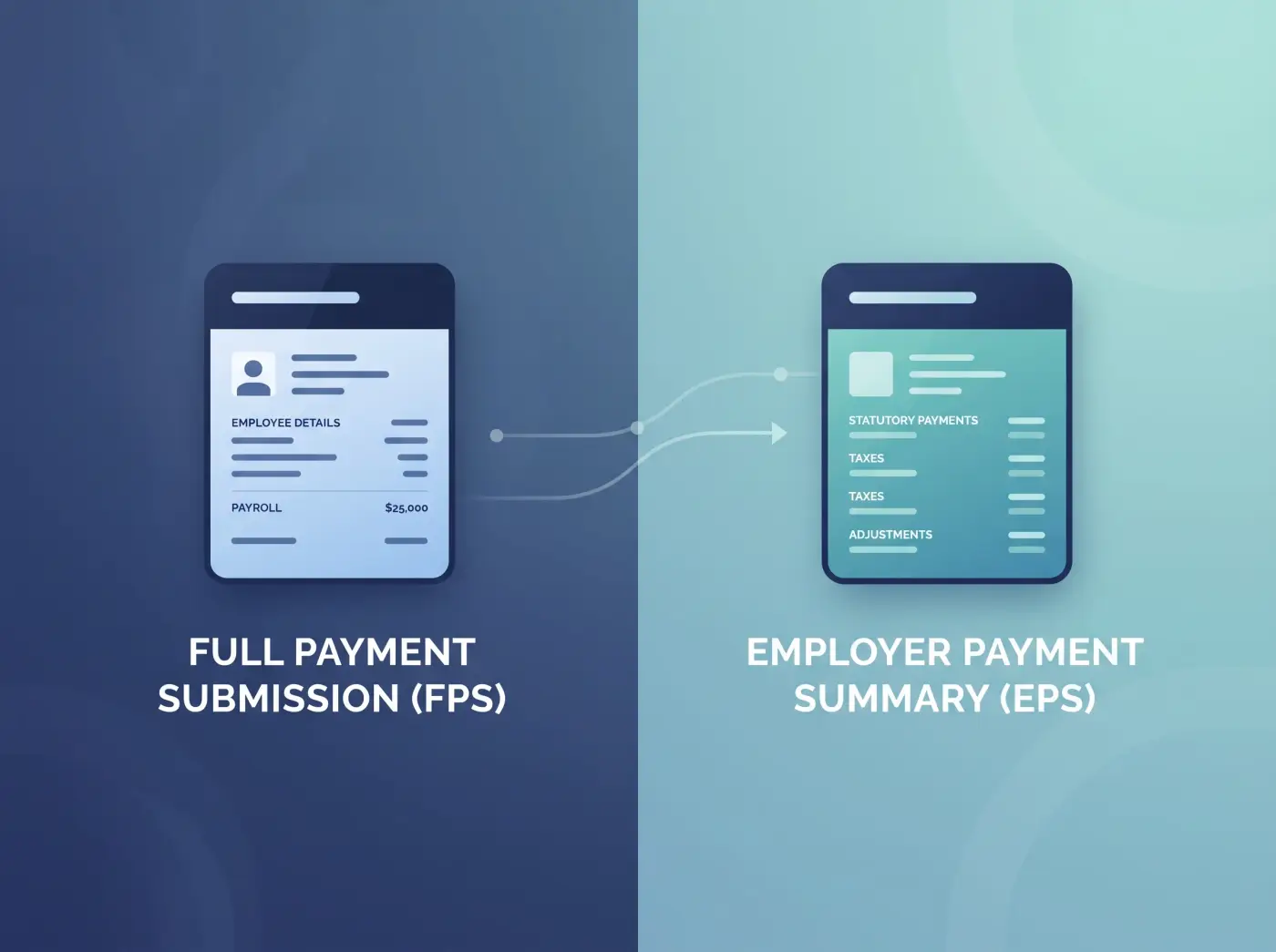
(For Illustrative Purposes Only)
Most employers have heard the term ‘RTI’ thrown around but have no idea it covers different submission types, each doing a specific job. Knowing which one applies and when saves you from HMRC assuming the worst.
Full Payment Submission (FPS) and What Goes Inside It
The FPS is the main RTI submission, sent every payday. It reports each employee’s pay, tax deducted, National Insurance contributions, student loan deductions, and pension contributions.
It also carries each employee’s tax code, NI number, and year-to-date figures, so HMRC always has an accurate running total. Miss a detail here, or send it after payday instead of before, and it counts as a late filing for that tax month.
Employer Payment Summary (EPS) and When You Actually Need One

(For Illustrative Purposes Only)
An EPS is not sent every payday. You need one when you have had no employees to pay in a tax month, when reclaiming statutory payments such as SMP or SSP, when claiming Employment Allowance, or when offsetting CIS deductions suffered by a limited company.
The EPS deadline is the 19th of the month following the tax month it relates to (remember, a UK tax month runs from the 6th of one month to the 5th of the next, so an EPS for the period of 6th April to 5th May is due by 19th May). Skip both the FPS and the EPS in a tax month, and HMRC does not assume you have gone quiet. It assumes you owe money and creates an estimated PAYE charge based on your previous filing pattern.
NI Number Verification Request (NVR) and Why It Exists
An NVR checks that an employee’s National Insurance number matches HMRC’s records, either before or shortly after hiring. It is not a routine payroll submission like the FPS or EPS, but it is part of the same RTI framework and helps avoid mismatches that can cause payroll headaches further down the line.
RTI Filing Deadlines That Trip Up Small Businesses
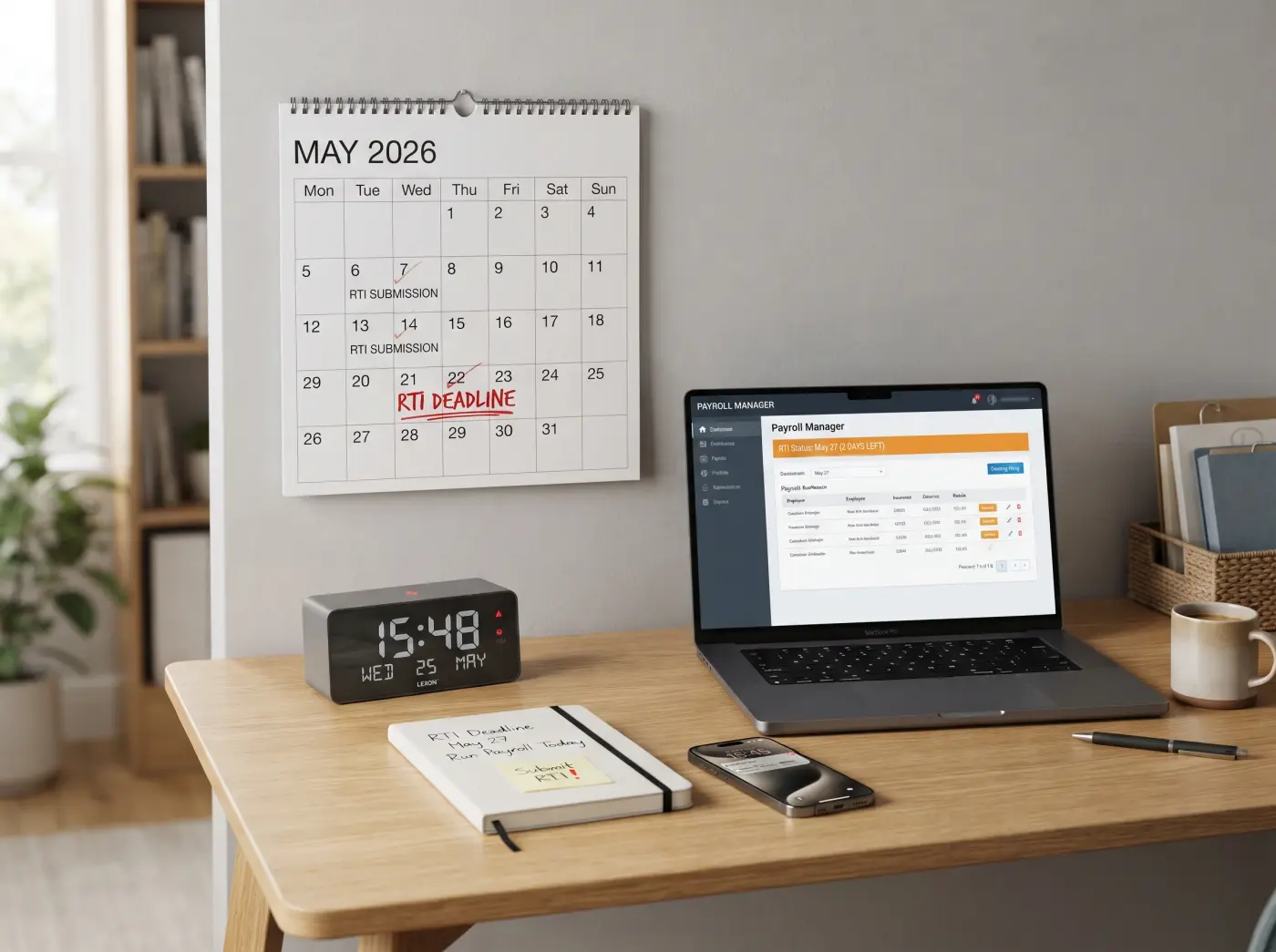
(For Illustrative Purposes Only)
Deadlines are where most RTI problems start, because employers assume they have until the end of the month when they actually have until payday itself. Getting the timing wrong, even by a single day, counts as a late filing.
The On or Before Payday Rule for Your FPS
Your FPS must reach HMRC on or before the date you pay your employees. Not the next working day. Not the end of the week. On or before, every single time.
The 19th of the Month Deadline for Your EPS

(For Illustrative Purposes Only)
Your EPS is due by the 19th of the month following the tax month it relates to. This gives you a window to report no-pay months or reclaim statutory payments, but it does not stretch or move regardless of your own payroll calendar.
What Happens When Payday Falls on a Weekend or Bank Holiday
HMRC still expects the FPS on or before the actual payday, even if that date lands on a Saturday, Sunday, or bank holiday. This means submitting before the weekend hits, not after it, particularly if you rely on BACS payment processing that needs lead time.
Some employers with irregular payment patterns, such as those who pay staff on the same day work is completed, may qualify for up to seven extra days under specific HMRC guidance in CWG2. This is a narrow exception and should never be treated as a general grace period. If your payday sits close to a bank holiday, build your payroll calendar around the earlier deadline, not the later one.
How HMRC Penalises You for Filing RTI Late

(For Illustrative Purposes Only)
HMRC does not negotiate on RTI deadlines. Miss one and the penalty machine starts ticking automatically, with no manual review and no warning call.
Monthly Late Filing Penalties by Employer Size (£100 to £400)
Under Schedule 55 of the Finance Act 2009, penalties scale with the size of your workforce:
| Number of Employees | Monthly Penalty |
|---|---|
| 1 to 9 | £100 |
| 10 to 49 | £200 |
| 50 to 249 | £300 |
| 250 or more | £400 |
These figures apply per tax month, per PAYE scheme, regardless of how many separate late filings occur within that month. HMRC only charges one penalty per scheme per tax month.
The 5% Surcharge When You Are More Than Three Months Late

(For Illustrative Purposes Only)
If your FPS is more than three months overdue, HMRC adds a further penalty of 5% of the tax and National Insurance you should have reported. This sits on top of the monthly penalty, not instead of it, so a badly delayed filing gets expensive fast.
Quarterly Penalty Notices and How They Stack Up Fast

(For Illustrative Purposes Only)
HMRC does not issue these penalties the moment they happen. Notices go out in batches, four times a year, in July, October, January, and April. A business could rack up three months of unpaid penalties before the first notice even arrives, which is exactly why so many employers are blindsided by the total on the letter.
Separate Penalties for Each PAYE Scheme You Operate
If you run more than one PAYE scheme, perhaps across separate trading entities or locations, penalties apply separately to each one. A late filing on scheme A does not roll into scheme B. Each scheme carries its own compliance record and its own penalty exposure.
Your One Free Pass and the Three-Day Grace Period
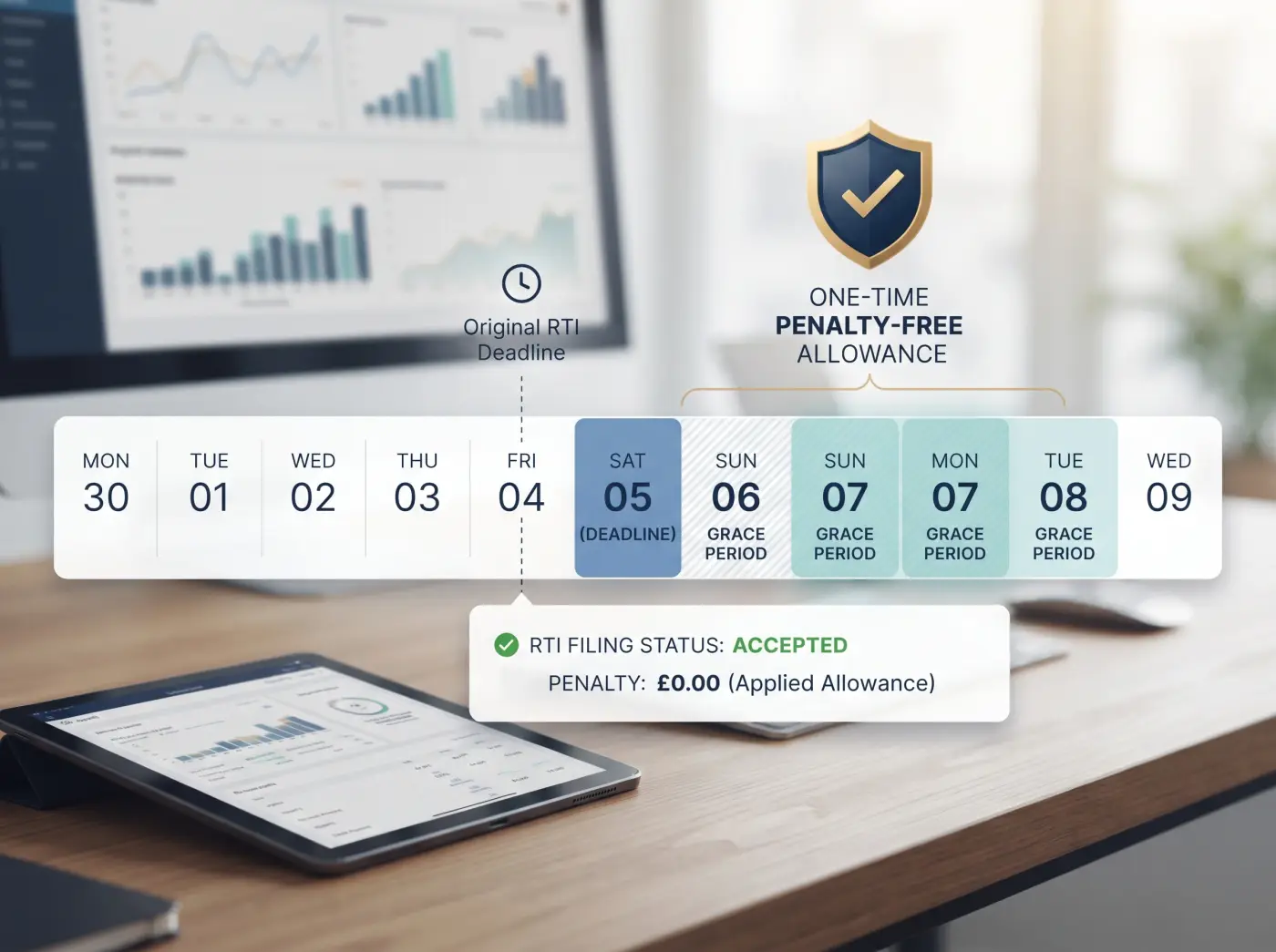
(For Illustrative Purposes Only)
HMRC is not completely heartless about this. A handful of built-in protections exist, but most employers only discover them after a penalty notice has already landed.
First Default of the Tax Year Gets No Penalty
HMRC does not charge a penalty for the first late FPS filing in each tax year, per the PAYE scheme. One free pass, no explanation required. The second late filing in the same tax year, however, triggers the full penalty straight away.
The Informal Three-Day Window HMRC Still Allows
HMRC has historically operated an informal easement where no penalty applies if the FPS arrives within three days of the actual payday, provided there is no pattern of persistent late filing. This is not written into legislation, which means HMRC can withdraw it at any point without notice. Treat it as a safety net, not a plan.
New Employers Get 30 Days Grace on Their First FPS
If you have just registered as an employer, your very first FPS will not be penalised as long as it reaches HMRC within 30 days of your first payment to an employee. After that first submission, the standard on-or-before rule applies without exception.
Why Persistent Late Filers Lose All Protection
HMRC monitors filing patterns across every PAYE scheme. Employers who repeatedly file late, even within the informal three-day window, get flagged as persistent late filers. Once flagged, the grace period protection disappears, and every late submission from that point starts attracting penalties.
How to Appeal an RTI Penalty With HMRC
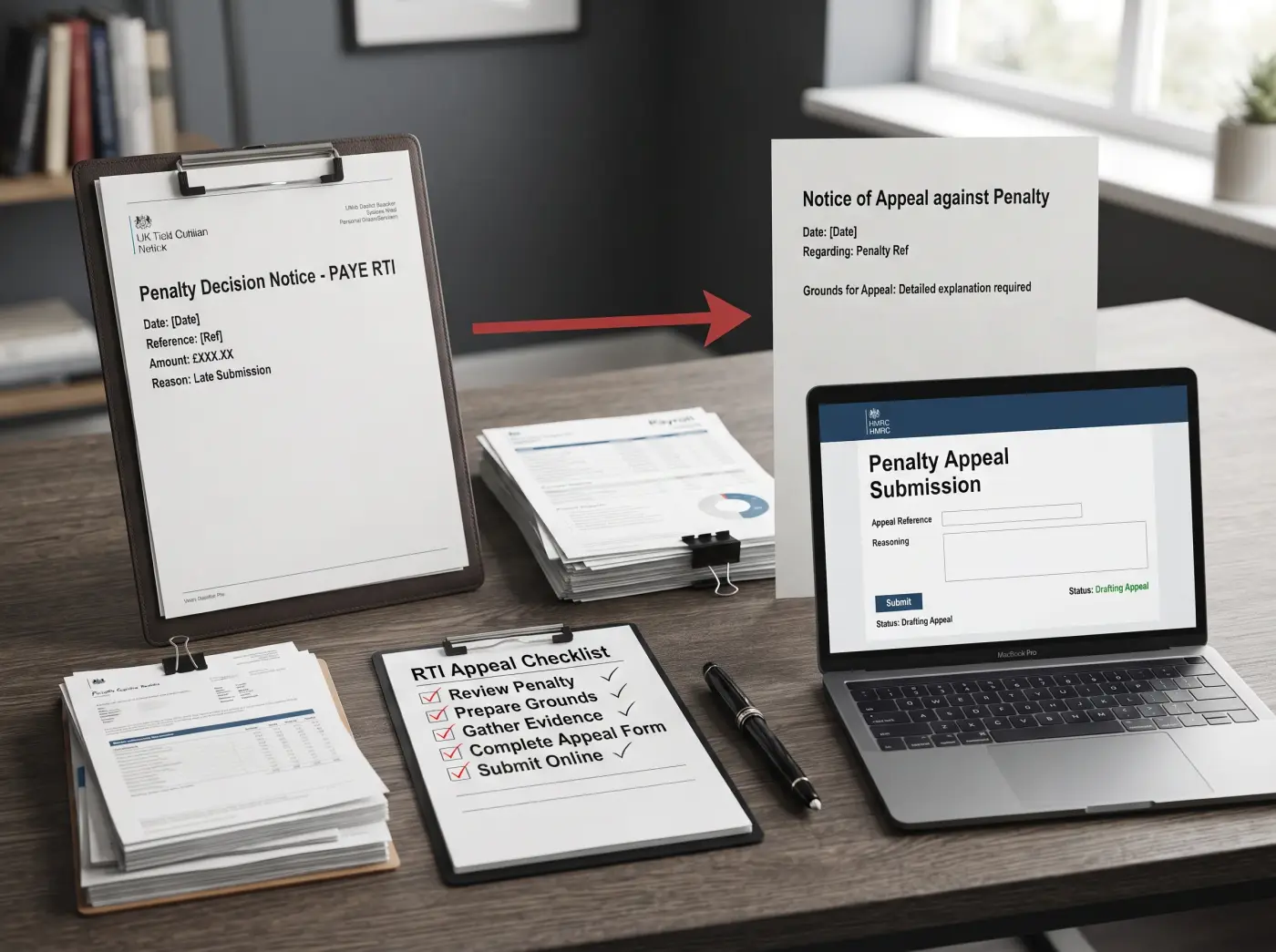
(For Illustrative Purposes Only)
Getting a penalty notice does not mean the conversation is over. HMRC accepts appeals where a genuine, evidenced reason explains the delay.
What Counts as a Reasonable Excuse
HMRC recognises a limited set of circumstances as a reasonable excuse:
- Serious illness or bereavement affecting the person responsible for payroll
- Fire, flood, or another natural disaster
- HMRC system downtime that prevented submission
- Postal delays entirely outside your control
- Loss of records through theft or fire
- Excuses HMRC Will Reject Every Time
Excuses HMRC Will Reject Every Time
Some explanations get rejected without much consideration. These include:
- “I did not know I had to file.”
- “My accountant forgot.”
- “I was too busy running my business.”
- “I thought there was a grace period.”
- How to Write Your Appeal Letter
How to Write Your Appeal Letter

A strong appeal letter needs specific information, not a general complaint. Include your PAYE reference, the penalty reference number, and the exact tax months affected.
State the reasonable excuse clearly, attach supporting evidence such as a medical certificate or an HMRC system status notice, and confirm when the issue was resolved and the submission actually made. Vague or emotional appeals with no evidence rarely succeed.
Escalating to the First Tier Tribunal If HMRC Says No
If HMRC rejects your appeal, you can request an independent review within HMRC or escalate to the First Tier Tribunal Tax Chamber. This route takes longer and involves a formal hearing process, so it suits cases where the penalty amount is significant, and the excuse is well evidenced.
Common RTI Mistakes That Trigger Penalties Without You Realising

(For Illustrative Purposes Only)
Most RTI penalties do not come from deliberate non-compliance. They come from small gaps in process that nobody noticed until the penalty notice arrived.
Forgetting to Send an EPS in a Month With No Pay Runs
If you do not pay any employees in a tax month and do not send an EPS to explain that, HMRC’s system assumes you failed to file and creates an estimated PAYE charge. Seasonal employers and businesses between staff hires fall into this trap constantly, because it feels natural to assume no pay run means no reporting duty.
Submitting Your FPS After Payday Instead of On or Before
Even one day late counts as a late filing for that entire tax month. There is no partial credit for being close and no leniency for a payroll run that slipped by 24 hours because of a bank processing delay.
Using the Wrong PAYE Reference or Employee Details
Incorrect PAYE references, wrong NI numbers, or mismatched employee names cause submissions to fail outright or create data mismatches that HMRC treats as non-submission. Double-check these details every time you onboard a new employee, particularly if you are transferring records between payroll systems.
Not Sending a Final FPS When an Employee Leaves
When someone leaves your business, their final FPS needs to include the leaving date. Without it, HMRC keeps expecting further submissions for that person, which creates confusion in your compliance record and can flag your scheme as having missing data. If you are unsure how your business structure affects payroll reporting duties, our guide on small business bookkeeping covers the wider record-keeping habits that support accurate RTI filing.
How to Stay RTI Compliant Without the Stress

(For Illustrative Purposes Only)
RTI compliance is not difficult once a system is in place, but most small businesses only build one after they have already been fined. Getting ahead of the deadlines costs far less than fixing the damage afterwards.
Choosing Payroll Software That Submits Automatically
HMRC-recognised payroll software files the FPS automatically on or before payday, removing the risk of human error on timing. HMRC’s own Basic PAYE Tools is free and suits very small employers, while Sage, Xero Payroll, and BrightPay offer more features for growing teams.
Setting Up Calendar Reminders for EPS Deadlines

(For Illustrative Purposes Only)
Set a recurring reminder for the 14th of each month to check whether an EPS is needed before the 19th deadline. This five-minute check catches no-pay months, statutory payment reclaims, and Employment Allowance claims before they slip past you.
Why Outsourcing Payroll to an Accountant Removes the Risk
Handing payroll to an accountant means someone else takes responsibility for every submission, every deadline, and every HMRC query that follows. It removes the single point of failure that comes from one person juggling payroll alongside everything else in the business.
What KG Business Handles for You
KG Business Services processes pay runs on time, submits every FPS and EPS to HMRC, and issues payslips without you needing to chase a deadline. The team manages auto-enrolment pension deductions, handles year-end returns including P60S, and deals directly with HMRC on penalty queries or compliance checks when they arise.
If payroll deadlines are eating into time better spent running your business, get in touch for a fixed-fee payroll quote.
Conclusion
RTI is a payday reporting duty, not a year-end task, and treating it as anything else is where most penalties begin. The FPS goes in on or before payday, the EPS covers no-pay months and reclaims by the 19th, and HMRC’s penalty bands run from £100 to £400 a month depending on employer size, with a 5% surcharge once a filing passes three months late.
Build a routine around checking your payroll data before each pay run, keeping submission receipts, and reconciling what HMRC says you owe against your own records. A first-default concession and an informal three-day window exist, but neither replaces a proper process, and persistent late filers lose that protection quickly.
Frequently Asked Questions
What is the difference between an FPS and an EPS?
The FPS reports pay, tax, and deductions for every employee and gets sent on or before each payday. The EPS is used separately for months with no pay runs, statutory payment reclaims, Employment Allowance claims, or CIS offsets, and it follows a monthly deadline of the 19th rather than a payday-linked one.
Do I still need to file RTI if I only have one employee?
Yes, RTI applies to every employer with a PAYE scheme regardless of how many people they employ. One employee on minimum wage carries the same reporting duty as a business with fifty staff.
Does HMRC charge a penalty for every late FPS in the same month?
No, HMRC only charges one penalty per PAYE scheme per tax month, even if multiple FPS submissions within that month are late. Separate PAYE schemes are still assessed individually.
What happens if I submit my EPS late?
A late EPS does not automatically create a penalty in the same way a late FPS does, but failing to submit one when required (such as in a no-pay month) can trigger an estimated PAYE charge from HMRC. It also delays any statutory payment reclaims or Employment Allowance claims tied to that submission.
Is there still a three-day grace period for late FPS filing in 2026/27?
HMRC continues to operate this informally, allowing FPS submissions within three days of payday without penalty in many cases. It has never been written into legislation, so HMRC can withdraw it at any time, and persistent late filers lose access to it regardless.
Can I correct an FPS after it has been sent to HMRC?
Yes, errors in a submitted FPS can be corrected through a further submission showing accurate year-to-date figures. Correcting promptly limits the chance of HMRC treating the discrepancy as a filing failure.
Can my accountant file RTI submissions on my behalf?
Yes, accountants and payroll bureaus routinely file FPS and EPS submissions for their clients using HMRC-recognised software. The responsibility for accuracy and timing still sits with the employer, so it pays to confirm your accountant has your correct PAYE reference and employee details from day one.