The employer NIC rate jumped from 13.8% to 15% in April 2025. At the same time, the Secondary Threshold, the point where you start paying NIC on an employee’s wage, dropped from £9,100 to £5,000. Both changes carry straight into the 2026/27 tax year without any softening.
That is a double hit, not a single price rise. It adds hundreds of pounds per employee per year to your payroll bill, and it catches out a lot of business owners who only clocked the headline rate and missed the threshold change sitting underneath it.
There is some relief. The Employment Allowance rose to £10,500, and the old £100,000 eligibility cap was scrapped, so more businesses qualify than before. Plenty of small employers still are not claiming it, either because they missed the change or assumed they did not qualify.
This article sets out the exact rates and thresholds for 2026/27, works through real cost examples for different salary levels, explains who can and cannot claim Employment Allowance, and covers director salary planning and legal ways to bring your NIC bill down.
What Changed With Employer National Insurance

(For Illustrative Purposes Only)
Most small business owners saw “15%” and assumed a modest increase from the old 13.8%. Once you factor in the threshold change alongside it, the real cost jump on a typical salary works out far higher than 1.2 percentage points suggests.
The Jump From 13.8% to 15% and Why It Is Not Just 1.2%
The employer NIC rate rose from 13.8% to 15% from 6 April 2025, under the National Insurance Contributions (Secondary Class 1 Contributions) Act 2025, announced in the Autumn Budget 2024. This rate carries forward unchanged into the 2026/27 tax year. HMRC treats this as a structural rate change rather than a temporary measure, so there is no expectation of it reversing.
The Secondary Threshold Drop From £9,100 to £5,000

(For Illustrative Purposes Only)
The Secondary Threshold, the earnings level above which employer NIC applies, fell from £9,100 to £5,000 per year at the same time as the rate rise. In monthly terms, employer NIC now starts above £417 of pay, not £758. That means employers pay NIC on a much bigger slice of every salary, on top of the higher rate.
Why the Double Hit Costs More Than the Headline Rate Suggests
Combine the two changes and the numbers move a lot more than they first appear to. On a £30,000 salary:
- Old rules: (£30,000 minus £9,100) x 13.8% = £2,884 per year
- New rules: (£30,000 minus £5,000) x 15% = £3,750 per year
That is an increase of roughly £866 per employee per year. Multiply that across a ten-person team, and it adds up to nearly £8,700 in extra employer NIC annually, before any relief is applied. For businesses setting up payroll for the first time, this cost needs building into hiring budgets from day one, not discovered after the first payslip run.
Employer NIC Rates and Thresholds for 2026/27 at a Glance

(For Illustrative Purposes Only)
Before you can plan your payroll budget, you need the exact figures HMRC applies for 2026/27. These rates and thresholds determine every employer NIC calculation you run through payroll this year.
The 15% Rate on Earnings Above £5,000
The standard employer NIC rate is 15% on earnings above the Secondary Threshold of £5,000 per year, £417 per month, or £96 per week. This applies to most employees on the standard category letter A, with no upper limit on the earnings the rate applies to, according to GOV.UK’s rates and thresholds guidance.
Reduced Rates for Employees Under 21 and Apprentices Under 25

(For Illustrative Purposes Only)
Employees under 21 in category letter M and apprentices under 25 in category letter H attract zero employer NIC until their earnings reach the Upper Secondary Threshold of £50,270 per year. Below that figure, employing a younger worker or apprentice costs nothing in employer NIC at all.
Class 1A NIC at 15% on Benefits in Kind
Class 1A NIC is also charged at 15% for 2026/27, but on the taxable value of benefits in kind rather than salary. This covers items reported on P11Ds, such as company cars or private medical insurance, and it is paid annually rather than through the monthly payroll run.
NIC Category Letters and Why They Matter

(For Illustrative Purposes Only)
The NIC category letter recorded against each employee determines which thresholds and rates apply to their pay. Common letters include A (standard), M (under 21), and H (apprentice under 25), along with letters for Freeports and Investment Zones. Using the wrong category letter is one of the most frequent payroll errors, and it can lead to overpaying or underpaying NIC for months before anyone notices.
How Much Extra Are You Actually Paying Per Employee?

(For Illustrative Purposes Only)
Percentages and thresholds mean little until you see the pound figures leaving your business account. These worked examples show the real cost difference between the old rules and 2026/27 rates.
Worked Example on a £25,000 Salary
On a £25,000 salary, the 2026/27 employer NIC bill is (£25,000 minus £5,000) x 15% = £3,000 per year. Under the old rules, it was (£25,000 minus £9,100) x 13.8% = £2,194. That is a difference of £806 per employee per year.
Worked Example on a £35,000 Salary
On a £35,000 salary, employer NIC under 2026/27 rules is (£35,000 minus £5,000) x 15% = £4,500. Under the old rules, it was (£35,000 minus £9,100) x 13.8% = £3,574. The gap here is £926 per year, larger than the £25,000 example because more of the salary sits above the lower old threshold.
What It Looks Like Across a Team of Five or Ten

(For Illustrative Purposes Only)
Across a five-person team on £30,000 average salaries, the extra £866 per head adds up to around £4,330 a year. Across ten staff, that becomes almost £8,660. These figures sit before any relief is applied.
Employment Allowance of £10,500 can offset much or all of this for smaller teams, but only if you actually claim it. A five-person team facing roughly £4,330 in extra cost could see that fully absorbed by the allowance; a ten-person team facing £8,660 would see most of it covered, depending on total payroll size.
Employment Allowance 2026/27: The £10,500 Relief That Offsets the Damage
(For Illustrative Purposes Only)
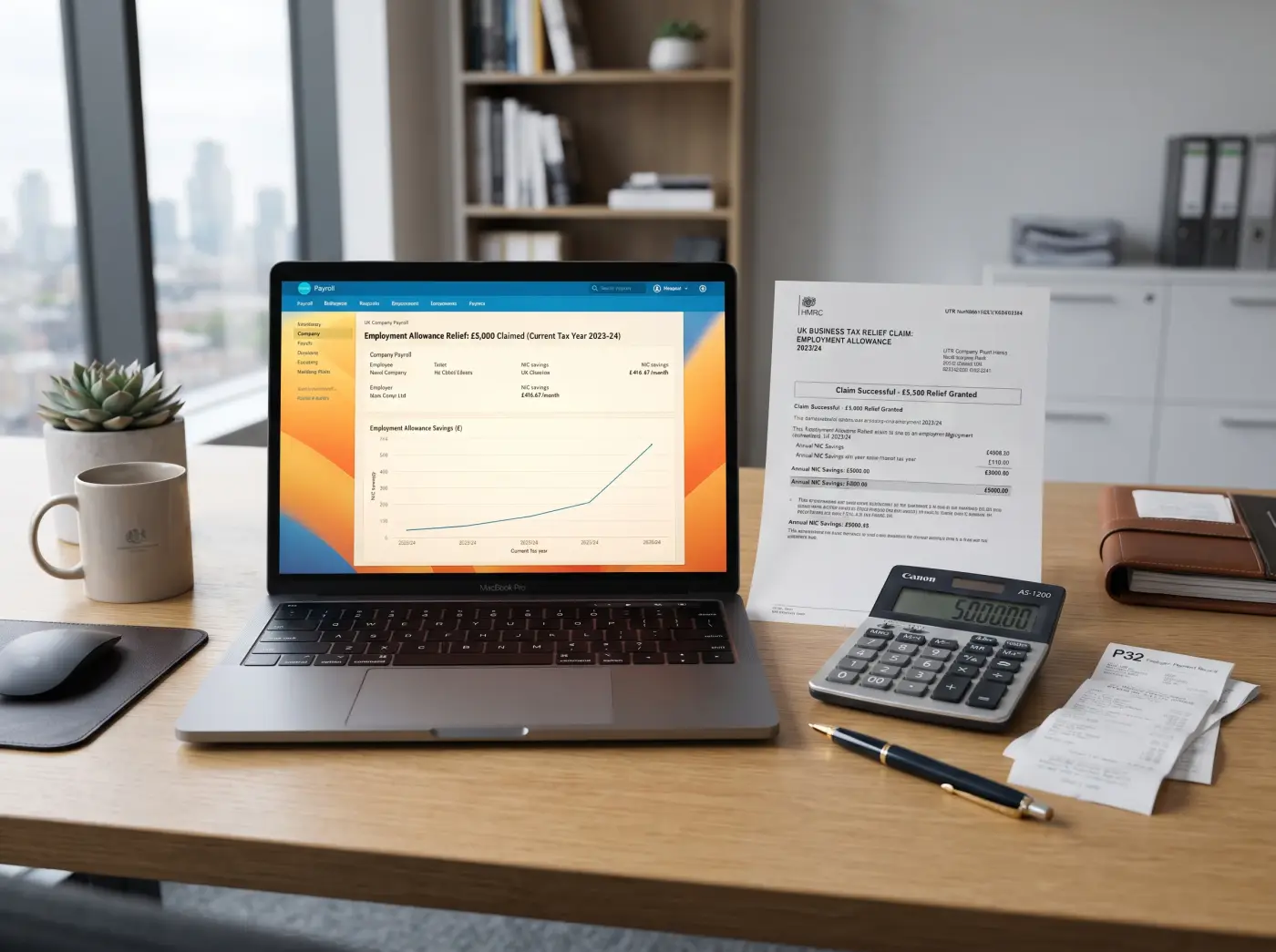
Employment Allowance is the single biggest relief available to small employers, and thousands of eligible businesses still are not claiming it. Getting this right can wipe out most or all of the extra cost from the 15% rate.
What Employment Allowance Is and How It Works
Employment Allowance reduces your employer’s Class 1 NIC bill by up to £10,500 per tax year. It works as an offset rather than a cash payment: on each payroll run, the employer NIC that would normally be due simply is not charged until the £10,500 allowance is used up for the year. Around 1.4 million employers claimed Employment Allowance in 2025/26.
Who Can Claim It (and the Single Director Trap That Catches Everyone)

(For Illustrative Purposes Only)
Most businesses with at least one employee other than a sole director can claim. The exception catches many small companies out: a limited company with only one director and no other employee paid above the £5,000 Secondary Threshold cannot claim employment allowance at all. This costs qualifying one-person companies around £1,135 a year in lost relief.
The old £100,000 prior-year employer NIC cap was removed from April 2025, opening the allowance to more employers. You cannot claim if more than half of your work is public sector funded.
Connected Companies and the One Claim Per Group Rule

(For Illustrative Purposes Only)
Connected companies, those under common control, can only claim one Employment Allowance between them, not one each. If a single company runs multiple PAYE schemes, only one of those schemes can claim the allowance.
How to Claim Through Your Payroll Software or EPS
The claim is made by selecting “Yes” on the Employment Allowance indicator within your Employer Payment Summary (EPS), or through HMRC’s Basic PAYE Tools if you run payroll manually. It must be claimed fresh each tax year; it is never applied automatically.
Backdating Your Claim for Up to Four Previous Tax Years

(For Illustrative Purposes Only)
You can backdate an Employment Allowance claim for up to four previous tax years if you were eligible but never claimed. Done correctly, this can recover as much as £25,500 in total across those years. Speak to your accountant or check your payroll setup before submitting a backdated claim.
Director Salary Planning Under the 15% Rate

(For Illustrative Purposes Only)
Director salary planning is one of the first conversations we have with new limited company clients, because getting the salary figure wrong costs real money every month it runs. The 15% rate and £5,000 threshold have shifted where the optimal salary level sits.
Why Most Small Company Directors Pay Themselves at the Secondary Threshold
Many directors set their salary at or near the £5,000 secondary threshold to avoid triggering employer NIC entirely. This figure sits below the Lower Earnings Limit of £6,708 for 2026/27, so directors relying solely on this salary level need to check whether they still qualify for a state pension credit year, since that requires earnings above the Lower Earnings Limit.
The Optimal Salary and Dividend Split for 2026/27

(For Illustrative Purposes Only)
A common approach pairs a modest salary with dividend income on top. The right split depends heavily on whether the company can claim Employment Allowance. Where the allowance is available, a slightly higher salary, above £5,000, can be more tax efficient overall, since the extra employer NIC is absorbed by the allowance rather than paid in cash, while still reducing Corporation Tax through the salary deduction.
When Paying Above the Threshold Still Makes Sense

(For Illustrative Purposes Only)
Paying a director above the secondary threshold can still make sense in several situations: maximising the Corporation Tax deduction on salary costs, building headroom for pension contributions, or supporting a mortgage application where lenders want to see a higher salary on record. Each of these trades a higher NIC cost against a different financial benefit, and the right balance depends on the individual company’s profits and the director’s personal circumstances. This is a decision worth reviewing with an accountant rather than setting once and forgetting, particularly around Corporation Tax for a limited liability company.
Practical Ways to Reduce Your Employer NIC Bill Legally

(For Illustrative Purposes Only)
The 15% rate is not changing, so the practical question is what you can do about the bill within HMRC’s rules. Several legitimate options reduce the amount you pay without touching your compliance obligations.
Hiring Under 21s and Apprentices Under-25 at Zero Employer NIC
Employees under 21 (category M) and apprentices under 25 (category H) attract zero employer NIC on earnings up to £50,270. This makes recruiting younger workers and apprentices genuinely cheaper than hiring an equivalent employee on the standard category A, since the entire salary up to that threshold carries no employer NIC cost.
Salary Sacrifice Pension Schemes That Cut NIC for Both Sides

(For Illustrative Purposes Only)
Under a salary sacrifice arrangement, an employee gives up part of their gross salary in exchange for a higher employer pension contribution. Because the sacrificed amount reduces gross pay, both employer and employee NIC are calculated on a lower figure, cutting the employer’s NIC bill and the employee’s own NIC and tax at the same time.
Freeport and Investment Zone Employer NIC Reliefs
Businesses operating in designated Freeport or Investment Zone areas can access zero employer NIC on earnings up to £25,000 per year for qualifying new hires, using the Freeport or Investment Zone Upper Secondary Threshold. This relief applies only within specific designated sites and specific qualifying roles.
Claiming Back Statutory Pay NIC Compensation
Employers who pay statutory maternity, paternity, or adoption pay can reclaim a percentage of it from HMRC. Standard employers can reclaim 92% of the gross statutory pay. If you qualify for Small Employers’ Relief (SER)—meaning your total Class 1 NIC liability was £45,000 or less in the previous tax year- you can reclaim 100% of the statutory payment plus an additional amount (currently 3%) in NIC compensation, totalling 103%.
How Employer NIC Affects Your Payroll, Corporation Tax and Cash Flow

(For Illustrative Purposes Only)
Employer NIC touches your profit and loss account, your corporation tax bill, and your monthly cash flow at the same time. Treating it as a single payroll line understates how it moves through the wider business.
Employer NIC Is a Tax-Deductible Business Expense
Employer NIC counts as an allowable deduction against corporation tax, so the net cost to the business is lower than the headline NIC figure. At the 25% Corporation Tax rate, every £1,000 paid in employer NIC reduces your Corporation Tax bill by £250, bringing the real net cost down to £750.
Budgeting Monthly for PAYE Liabilities

(For Illustrative Purposes Only)
Set aside employer NIC as a fixed part of your monthly payroll budget rather than treating it as a surprise bill each quarter. Building it into your regular cash flow forecast, alongside employee NIC and income tax deducted through PAYE, avoids a scramble to find funds when the payment is due.
The 22nd of the Month Payment Deadline and Cash Flow Timing
PAYE, employee NIC, and employer NIC must reach HMRC by the 22nd of the following month when paying electronically. Late payment triggers escalating penalties, so timing your cash flow around this date matters as much as budgeting the correct amount.
Mistakes Small Businesses Make With Employer NIC

(For Illustrative Purposes Only)
These are the employer NIC mistakes that land on our desk every month, and each one costs money that did not need to be spent. Most are avoidable with a quick check of the payroll setup.
Not Claiming Employment Allowance at All
Employment Allowance must be claimed each tax year through the EPS; it is never applied automatically. If you do not tick the claim indicator, HMRC will not apply the allowance for you, and you carry on paying the full employer NIC unnecessarily.
Applying the Wrong NIC Category Letter
The category letter on an employee’s payroll record determines which thresholds apply to their pay. The most common error is leaving an under-21 employee on category A instead of moving them to category M, which carries a much higher threshold before employer NIC applies.
Forgetting Class 1A NIC on Benefits in Kind

(For Illustrative Purposes Only)
Benefits in kind such as company cars, private medical insurance, and gym memberships attract Class 1A NIC at 15%. This is reported and paid separately from monthly payroll, with the P11D deadline set at 6 July following the tax year and the Class 1A payment due by 22 July.
Getting Directors’ Annual Earnings Period Calculations Wrong

(For Illustrative Purposes Only)
Directors are assessed on an annual earnings period for NIC purposes, rather than the weekly or monthly period used for other employees. Applying the wrong calculation method across the year leads to over- or underpaid NIC that only surfaces at year-end, when it is harder to correct cleanly.
What KG Business Does to Keep Your Employer NIC Right
Getting employer NIC right is not difficult once someone is watching the numbers every period, but getting it wrong costs money that cannot be recovered later. This is the core of what a properly run payroll service delivers for a small business.
Payroll Processing With Correct Thresholds and Category Letters
KG Business processes payroll using the correct 2026/27 rates and thresholds, applies the right NIC category letter for every employee, and submits FPS and EPS to HMRC on time every period. This removes the risk of category errors or missed threshold updates sitting unnoticed for months.
Employment Allowance Claimed From Day One
Eligibility for Employment Allowance is checked for every client at the start of the tax year, and the claim is made through the first EPS submission of that year. Where a client has been eligible in previous years but never claimed, backdated claims are reviewed and submitted where they still qualify.
Year End P60 and P11D Compliance
Year-end compliance includes issuing P60s to employees by 31 May and preparing P11Ds for any benefits in kind, with the resulting Class 1A NIC calculated and paid by the 22 July deadline. This keeps the whole payroll cycle, from monthly processing through to year-end reporting, working from the same accurate figures.
If your business needs a payroll setup that stays on top of employer NIC changes as they land, get in touch with KG Business for a fixed-fee payroll quote.
Frequently Asked Questions
What is the employer’s National Insurance rate for 2026/27?
The employer NIC rate for 2026/27 is 15% on employee earnings above the secondary threshold of £5,000 per year. This rate was introduced in April 2025 and continues unchanged into 2026/27.
How do I calculate employer NI on an employee’s salary?
Subtract the £5,000 annual secondary threshold from the employee’s gross annual salary, then multiply the result by 15%. For example, on a £30,000 salary: (£30,000 minus £5,000) x 15% equals £3,750 per year.
Do employers pay National Insurance on workers under 21?
No, for most under-21 employees. Employer NIC is zero on earnings up to £50,270 (the Upper Secondary Threshold) for employees under 21 on NIC category letter M. Employer NIC only applies above that figure.
Can a small limited company claim the Employment Allowance?
Most small companies can, provided they have at least one employee other than a sole director. A limited company with only one director and no other employee paid above £5,000 cannot claim, and at least one additional employee earning above the threshold is needed to qualify.
What is the secondary threshold for employer NIC in 2026/27?
The secondary threshold is £5,000 per year, equal to £417 per month or £96 per week. Employer NIC applies to earnings above this figure, at 15% for most employees.
How much extra does the 15% rate cost per employee compared to 13.8%?
On a £30,000 salary, the old cost was roughly £2,884 per year under the 13.8% rate and £9,100 threshold. Under the new rate and lower threshold, it is £3,750, an increase of about £866 per employee per year.
What happens if I do not claim Employment Allowance?
You continue paying full employer NIC with no relief applied, even if your business qualifies. Employment Allowance is never applied automatically; it must be claimed through your EPS each tax year, and missed years can sometimes be backdated for up to four years.