Going into business with someone you trust can feel like the obvious next step.
You bring one set of skills. They bring another. You split the workload, put your resources together, and build something neither of you might have tackled alone.
And when it works, a business partnership can work extremely well.
But there is another side to it.
You are not simply sharing the ideas and the profits. Depending on the type of partnership, you may also be sharing responsibility for debts, tax obligations, financial decisions, and mistakes. A disagreement that starts over something small can become a serious business problem when money and ownership are involved.
That is why we would never recommend choosing a business structure simply because it looks easiest at the beginning.
At KG Business Services, we work with small and medium-sized businesses and see how much easier financial management becomes when the foundations are right from day one.
So, if you are considering starting a partnership business in the UK, this guide will take you through the advantages, disadvantages, tax responsibilities, and practical questions worth asking before you commit.
What Is a Partnership in Business?

(For Illustrative Purposes Only)
A business partnership is a structure in which two or more people run a business together.
In an ordinary UK partnership, the partners personally share responsibility for the business. They also share its profits, with each partner paying tax on their respective share.
A partnership must choose a nominated partner, who takes responsibility for managing the partnership’s tax return and maintaining the appropriate business records.
That sounds straightforward enough.
The important part is understanding that entering a partnership is not simply two self-employed people agreeing to work together. You are creating a commercial relationship with financial and legal consequences.
Before asking, “How easy is it to start?” I would therefore ask:
Who am I starting it with, how will we make decisions, and what happens when circumstances change?
Those questions matter far more in the long run.
What Are the Main Features of a Partnership?
The precise position depends on the type of partnership, but an ordinary partnership business will typically involve:
- Two or more partners
- Shared responsibility for running the business
- An agreed division of profits
- Individual tax responsibilities for each partner
- A nominated partner responsible for the partnership tax return
- Shared business records
- Fewer corporate formalities than running a limited company
- Personal exposure to business liabilities
- An agreement between the partners about how the business will operate
One point is worth making here.
Simple does not mean responsibility-free.
You still need accurate financial records, properly prepared tax returns and a clear understanding of what belongs to the business and what belongs to each partner.
That distinction becomes increasingly important as the business grows.
What Types of Business Partnership Are They in the UK?

(For Illustrative Purposes Only)
Not every partnership is structured in the same way.
Before comparing the advantages and disadvantages of a partnership, you need to know which structure you are actually considering.
Ordinary Business Partnership
This is the structure most people mean when they talk about a business partnership.
Two or more partners operate the business and share its profits.
It is relatively straightforward to establish, but the personal liability attached to an ordinary partnership needs serious consideration.
Limited Partnership
A limited partnership is different.
It must contain at least one general partner and one limited partner.
The roles and liabilities of those partners differ, so this structure should not be confused with an ordinary partnership simply because both contain the word “partnership”.
Limited Liability Partnership (LLP)
A limited liability partnership, or LLP, is a separate type of structure.
It combines elements associated with partnerships with limited liability protection. LLP members are generally taxed individually on their share of profits, while their personal liability for debts the LLP cannot pay is normally limited.
An LLP also comes with additional registration, reporting and administrative responsibilities.
For the remainder of this guide, when I refer simply to a partnership, I am mainly talking about an ordinary business partnership unless stated otherwise.
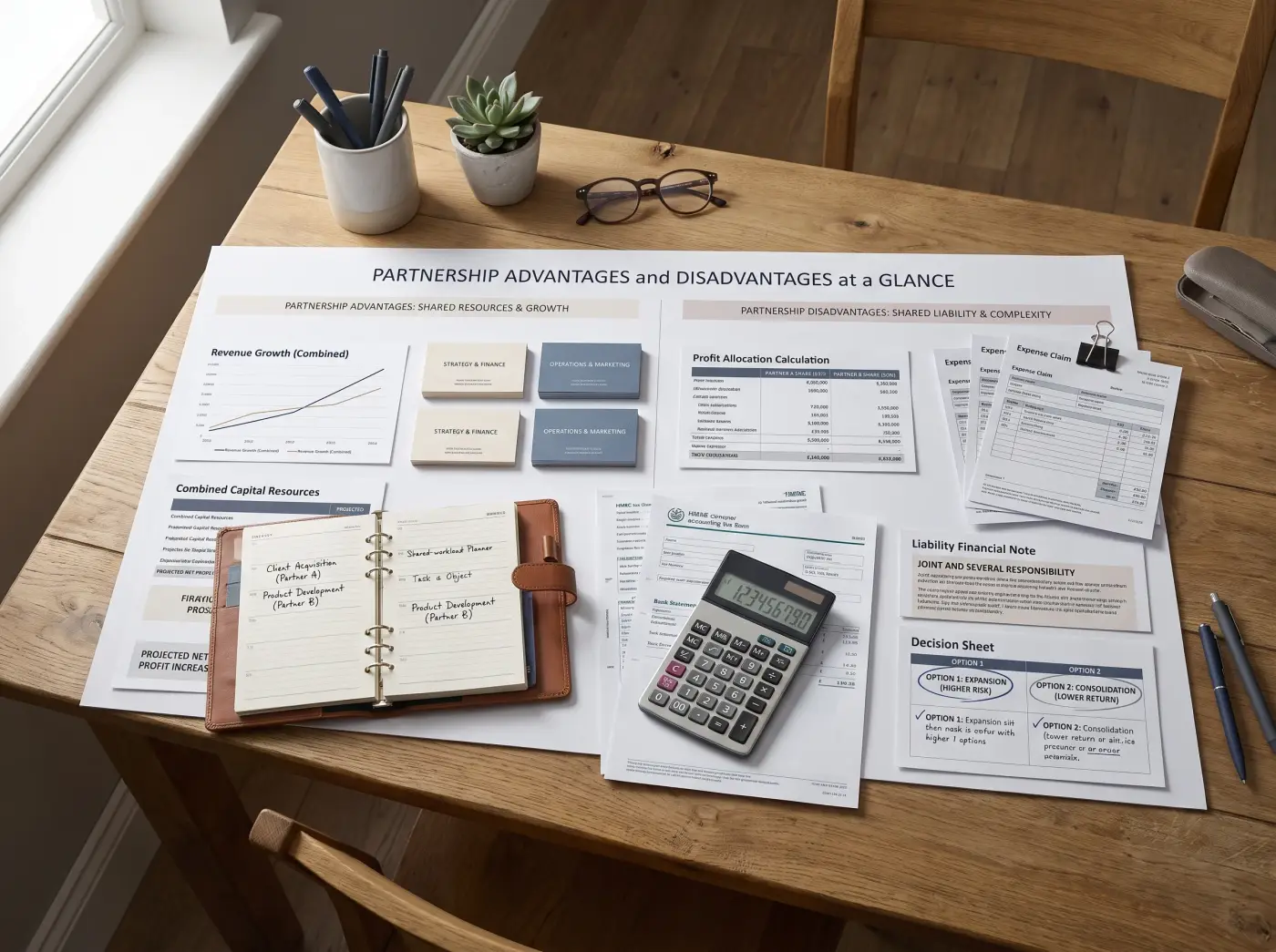
Partnership Advantages and Disadvantages at a Glance
(For Illustrative Purposes Only)
If you are comparing structures, here is the short version.
| Advantages of a partnership | Disadvantages of a partnership |
|---|---|
| Relatively straightforward to establish | Personal liability can be significant |
| Workload can be shared | Profits have to be shared |
| Partners can combine different skills | Disagreements can affect the business |
| More than one person can contribute capital | You give up some individual control |
| Decisions benefit from different perspectives | Decisions can sometimes take longer |
| Management can be flexible | One partner’s actions can affect others |
| Less public financial disclosure than a limited company | Changes in partners can create complications |
| Responsibilities do not fall on one person | External investment can be more difficult |
| Partners can bring different contacts and experience | Tax may become less attractive at higher profit levels |
| Can work well for owner-managed businesses | May become less suitable as a business grows |
That gives you the headline answer.
The details are where the decision gets interesting.
10 Advantages of a Partnership Business

(For Illustrative Purposes Only)
1. Partnerships Are Relatively Straightforward to Set Up
One of the biggest advantages of a partnership is simplicity.
Compared with forming and administering a limited company, an ordinary partnership generally involves fewer corporate formalities.
You still have responsibilities. The partnership needs to be registered with HMRC for Self Assessment, the other partners need to register separately, and suitable financial records need to be maintained.
But for two people starting a relatively straightforward owner-managed business, the structure can be attractive.
Our advice would be not to confuse easy setup with something you can afford to set up casually.
Spend time getting the financial arrangements right at the beginning.
It is much easier than trying to untangle them later.
2. You Can Share the Workload
Running a business alone can become exhausting very quickly.
Sales need attention.
Customers need answers.
Invoices need to be raised.
Suppliers need to be paid.
Records need to be maintained.
And somewhere in amongst all of that, you are supposed to actually deliver the work customers are paying you for.
With the right partner, those responsibilities can be divided sensibly.
Perhaps one partner is excellent with customers and business development while the other is stronger on operations.
That can be a powerful combination.
3. You Can Combine Different Skills
Two people who are exactly the same do not necessarily make the strongest partnership.
Complementary skills are often more useful.
Think about a trades business where one partner is outstanding technically but dislikes administration, while the other is organised, commercially minded and comfortable dealing with customers.
Or a consultancy where one partner has deep technical expertise while another is good at winning and managing client relationships.
A good partnership allows each person to concentrate more of their time where they add the most value.
4. You May Have More Capital and Resources
Starting alone means relying heavily on your own resources.
A partnership potentially gives the business access to contributions from several people.
Those contributions do not necessarily mean cash alone.
Partners might bring:
- equipment,
- industry contacts,
- an existing client base,
- premises,
- specialist knowledge, or
- valuable commercial experience.
That can give a new business a stronger starting position.
5. You Do Not Have to Make Every Decision Alone
Being your own boss sounds brilliant until you realise every difficult decision lands on your desk.
Having another experienced person involved can be valuable.
You can challenge each other’s assumptions, discuss problems and look at important decisions from different angles.
But this advantage only works when both partners respect each other’s roles.
Two people trying to control every decision can create the opposite result.
6. Responsibility Can Be Shared
There is a practical benefit in knowing everything does not stop because you are away for a day.
Customers can still be dealt with. Suppliers can still be contacted. Problems can still be resolved.
That shared responsibility can make a partnership more resilient than a business entirely dependent on one person.
However, shared operational responsibility should never be confused with protection from financial liability.
We will come to that shortly.
7. Partnerships Can Be Flexible
Partners can agree how they want to divide responsibilities, profits and day-to-day management.
One partner might work primarily on operations while another concentrates on finance and growth.
That flexibility can work particularly well for smaller businesses where rigid corporate structures would add unnecessary complexity.
The key word, however, is agree.
Do not leave important arrangements sitting in people’s heads.
Put them in writing.
8. There Is Generally Greater Financial Privacy
An ordinary partnership does not normally face the same public Companies House filing requirements as a limited company.
For some owner-managed businesses, that additional privacy is attractive.
That does not remove HMRC reporting or record-keeping responsibilities. It simply means the public disclosure position differs from that of a limited company.
9. Profits Flow Through to the Partners
Partnership profits are allocated between the partners according to the relevant arrangements, and each partner is generally taxed personally on their share.
For some businesses, that simplicity can be attractive.
But tax should never be considered in isolation.
What looks straightforward when profits are modest may look very different when the business becomes more profitable.
That is why business structure should be reviewed as the business develops rather than treated as a decision you make once and never revisit.
10. You Have Someone Else Invested in Making the Business Work
This advantage is often overlooked.
Employees can care deeply about a business, but an owner has a different level of financial and personal involvement.
With the right partner, you have another person who has genuine skin in the game.
When difficult months arrive, you are not facing them alone.
When opportunities appear, you have someone else motivated to make them work.
The crucial phrase there is the right partner.
Choose badly and almost every advantage above can turn into a disadvantage.
10 Disadvantages of a Partnership Business

(For Illustrative Purposes Only)
This is the part worth paying closest attention to before signing anything.
1. Personal Liability Can Put Your Own Finances at Risk
This is probably the most important of the disadvantages of a partnership.
In an ordinary UK partnership, partners personally share responsibility for losses and business bills.
In Scotland, there is an important legal distinction which I cover below, but partners can still ultimately become personally liable where the partnership cannot meet its debts.
That means you should understand your exposure before entering the arrangement.
Do not wait until the business owes money to find out how liability works.
2. Another Partner’s Decisions Can Affect You
A partnership requires trust for a reason.
The actions of one partner can create consequences for the partnership and potentially the other partners.
Imagine discovering that your business partner has committed to a significant expense you were not expecting.
Even where the relationship remains good, unclear authority creates unnecessary risk.
A sensible partnership agreement should therefore establish what partners can decide independently and which decisions require agreement.
3. You Have to Share the Profits
Sharing resources is an advantage.
Sharing profits is the other side of the deal.
If you build a profitable business, those profits are divided according to the partnership arrangements rather than belonging entirely to you.
That is not necessarily a problem.
It becomes a problem when one partner believes they are contributing considerably more than another.
Which leads neatly to the next issue.
4. Disagreements Can Become Personal
Business disagreements are normal.
Partnership disputes are different because ownership, money and personal relationships are mixed together.
Common arguments include:
- who is working harder,
- how much money should be withdrawn,
- whether profits should be reinvested,
- whether to hire employees,
- which customers to pursue,
- how much debt to take on,
- whether to expand, and
- where the business should go next.
If two partners want completely different things from the business, the problem rarely fixes itself.
Talk about those issues before they become issues.
5. You Give Up Some Control
As a sole trader, you can decide on Monday morning that you want to change direction.
It is your business.
A partnership is different.
Major decisions should involve the other partners.
For some people, that collaboration is one of the biggest benefits.
For someone who strongly prefers making decisions independently, it can become one of the biggest frustrations.
6. Decisions Can Take Longer
Two heads can be better than one.
They can also take twice as long to agree.
The problem becomes particularly noticeable when responsibilities overlap or partners have equal authority but no process for breaking a deadlock.
This is another reason we keep returning to the importance of a partnership agreement.
Good paperwork does not replace trust.
It protects the business when trust alone is not enough to resolve a situation.
7. Raising External Investment Can Be More Difficult
If your long-term ambition involves bringing in multiple outside investors, an ordinary partnership may not provide the cleanest structure.
A limited company has shares and a more familiar mechanism for introducing equity investors.
That does not automatically mean every ambitious business should become a limited company.
It means your future plans matter when choosing your structure today.
8. A Partner Leaving Can Cause Serious Disruption
People’s lives change.
A partner might:
- retire,
- become ill,
- move away,
- want to start another business,
- need access to their capital,
- fall out with another partner, or
- simply decide they no longer want to continue.
What happens to their interest?
Who values it?
Can the remaining partners buy it?
Can somebody new join?
Those questions are much easier to answer when you have agreed on the process while everyone is still getting along.
9. The Tax Position May Become Less Attractive as Circumstances Change
There is a dangerous habit online of saying either:
“Partnerships are more tax efficient.”
or:
“Limited companies are more tax efficient.”
Neither statement is sensible without context.
Your actual position depends on factors such as:
- business profits,
- how profits are divided,
- other personal income,
- allowances and reliefs,
- how much money owners need personally,
- pension arrangements,
- future investment plans, and
- the wider circumstances of the owners.
Tax rules also change.
Choose a structure based on actual figures and plans rather than a general statement you read online.
10. The Structure May Become Less Suitable as You Grow
A partnership that works perfectly for two people turning over a modest amount can become cumbersome when the business expands.
You might begin employing more people.
Profits may increase.
You might seek investment.
One partner may want to exit.
You may want stronger separation between personal and business finances.
At that point, reviewing whether an LLP or limited company is more appropriate can make sense.
Changing structure is not evidence that the original decision was wrong.
Businesses change.
Their financial structures should sometimes change with them.
Scottish Partnerships: One Difference Business Owners Should Know

(For Illustrative Purposes Only)
Because KG Business Services is based in Clydebank, this point is particularly relevant to many businesses we speak to.
Scottish partnerships have an important legal distinction.
Under Scots law, a partnership or firm has a legal personality distinct from the individual partners who make it up.
That differs from the general position elsewhere in the UK.
But there is an important warning.
Separate legal personality does not mean the partners have the same protection as shareholders of a limited company.
Where a Scottish partnership does not have sufficient assets to meet its debts, the partners can become liable.
So if somebody tells you:
“A Scottish partnership is a separate legal person, so your personal finances cannot be touched.”
That is an oversimplification you should not rely upon.
This is exactly why understanding the structure properly matters before making decisions based purely on convenience.
How Is a Business Partnership Taxed in the UK?

(For Illustrative Purposes Only)
This is where many new partnerships start feeling less simple.
A partnership is ‘tax transparent’, meaning the business itself does not pay corporation tax or income tax. Instead, the partnership calculates the business’s overall profit or loss and reports this to HMRC through an SA800 Partnership Tax Return. The nominated partner is responsible for submitting that return.
Each individual partner must then submit their own individual self-assessment tax return (including the SA104 partnership pages). You are personally responsible for paying income tax and National Insurance on your specific share of the profits.
(Note: National Insurance rates for the self-employed have changed recently, with the main rate of Class 4 NICs dropping to 6% and Class 2 being effectively abolished as a mandatory cash payment for most, so calculating your exact liabilities requires up-to-date tax knowledge).
In other words:
Partnership return + individual partner returns.
That is one reason good bookkeeping from the start matters.
Trying to reconstruct a year’s transactions shortly before the tax deadline is stressful enough for one person.
Doing it while several partners are trying to establish who paid for what is worse.
When Does a Partnership Need to Register for VAT?
VAT is based on taxable turnover rather than whether you call yourself a partnership, sole trader or limited company.
At the time of writing, compulsory VAT registration generally applies when VAT taxable turnover exceeds £90,000, although voluntary registration may also be possible below the threshold.
Do not simply wait until year-end to check.
Turnover needs monitoring throughout the year.
KG Business Services provides VAT return support, including VAT compliance, Making Tax Digital requirements and guidance around available VAT schemes.
Keep the Books Clean From Day One
This sounds basic, but it solves an extraordinary number of problems.
A partnership should be able to see:
- income,
- expenditure,
- outstanding invoices,
- money owed to suppliers,
- partner contributions,
- drawings,
- VAT where applicable, and
- the overall financial position.
KG Business Services provides bookkeeping support using platforms including Xero, QuickBooks and Sage, helping businesses maintain reliable financial records rather than treating bookkeeping as a year-end rescue job.
Do You Need a Partnership Agreement?

(For Illustrative Purposes Only)
To put this simply:
Starting a partnership without discussing what happens when things go wrong is taking an unnecessary risk.
A partnership agreement can establish how the relationship will operate.
It should address matters such as:
- How much capital is each partner contributing?
- How are profits and losses divided?
- Who is responsible for which part of the business?
- Which decisions can one partner make alone?
- Which decisions require everyone to agree?
- How are drawings handled?
- Can new partners join?
- What happens if somebody wants to leave?
- What happens if a partner becomes seriously ill or dies?
- How will disputes be resolved?
- How will a departing partner’s interest be valued?
- What happens if the business closes?
KG Business Services can help with the financial and accounting side of running your business, but a partnership agreement is a legal document. Appropriate legal advice should be taken when preparing one.
That distinction matters.
Your accountant and solicitor have different jobs. Good businesses use each professional for the area they are qualified to handle.
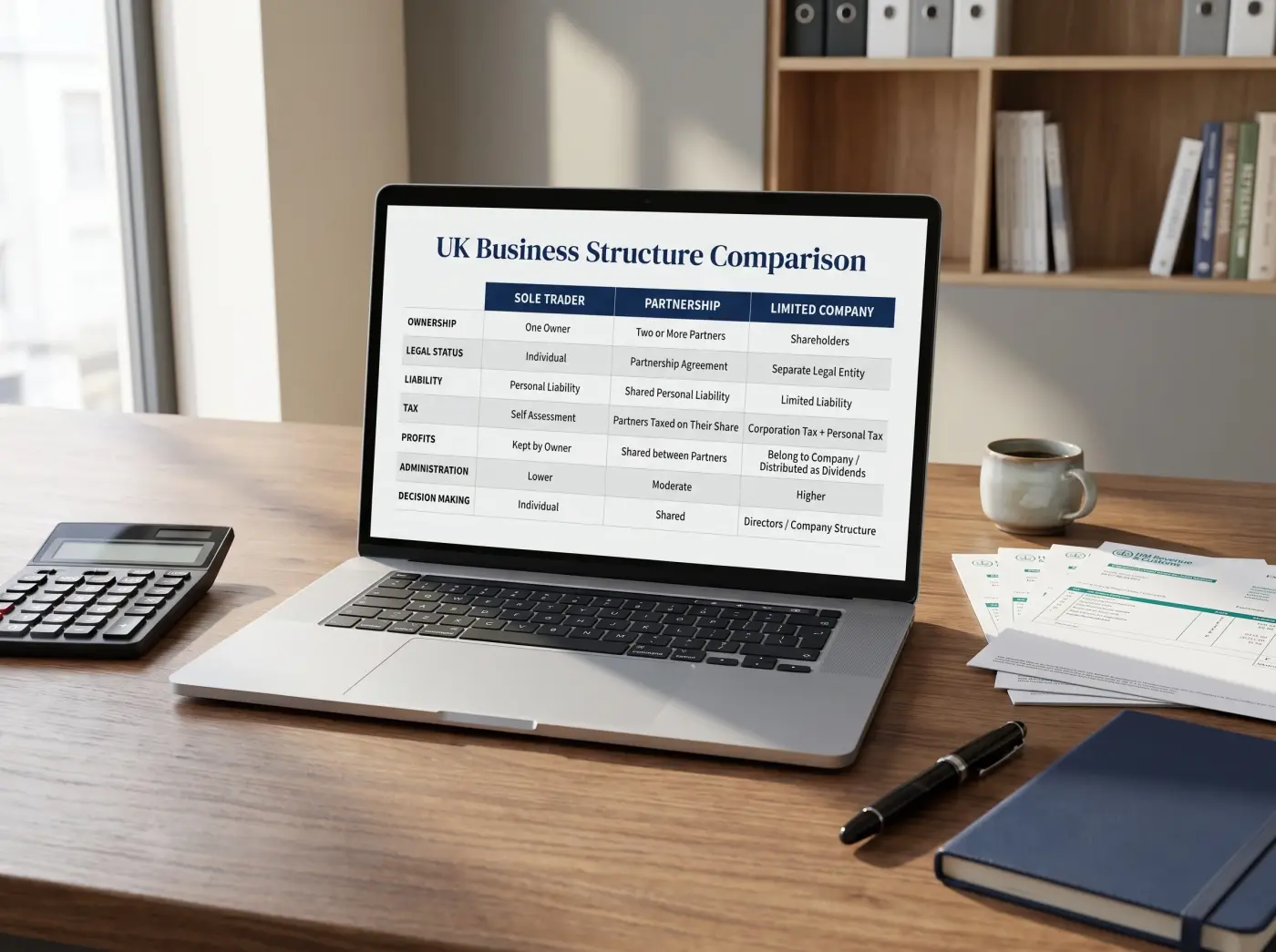
Partnership vs Sole Trader vs Limited Company
(For Illustrative Purposes Only)
There is no universal “best” business structure.
There is only the structure that fits your circumstances better.
| Question | Sole trader | Ordinary partnership | Limited company |
|---|---|---|---|
| Owners | One individual | Two or more partners | One or more shareholders |
| Day-to-day control | Individual | Shared | Directors manage the company |
| Personal liability | Generally unlimited | Personal exposure applies | Normally limited |
| Tax on profits | Individual | Partners individually | Company pays Corporation Tax |
| Companies House obligations | No | Generally no for ordinary partnerships | Yes |
| Public filing | Limited | Limited | Greater |
| Administration | Relatively simple | Relatively simple | More formal |
| Profit ownership | Owner | Divided between partners | Belongs to company |
| Bringing in equity investors | Limited | Can be awkward | Usually more straightforward |
| Best suited to | Individual businesses | Joint owner-managed businesses | Businesses wanting corporate separation or scalable ownership |
Partnership vs Sole Trader
A sole trader structure can make sense when you are running the business yourself and want straightforward control.
A partnership becomes relevant when two or more people genuinely intend to own and operate the business together.
Do not add somebody as a partner merely because they occasionally help with the business.
Ownership has consequences.
Partnership vs Limited Company
This comparison requires more thought.
A limited company has its own legal identity and usually provides shareholders with limited liability.
It also comes with corporation tax and Companies House obligations.
An ordinary partnership can involve less corporate administration, but the liability position is less protective.
The right answer, therefore, depends on far more than which option involves less paperwork.
You need to think about:
risk, profits, tax, investment, ownership, growth and exit plans.
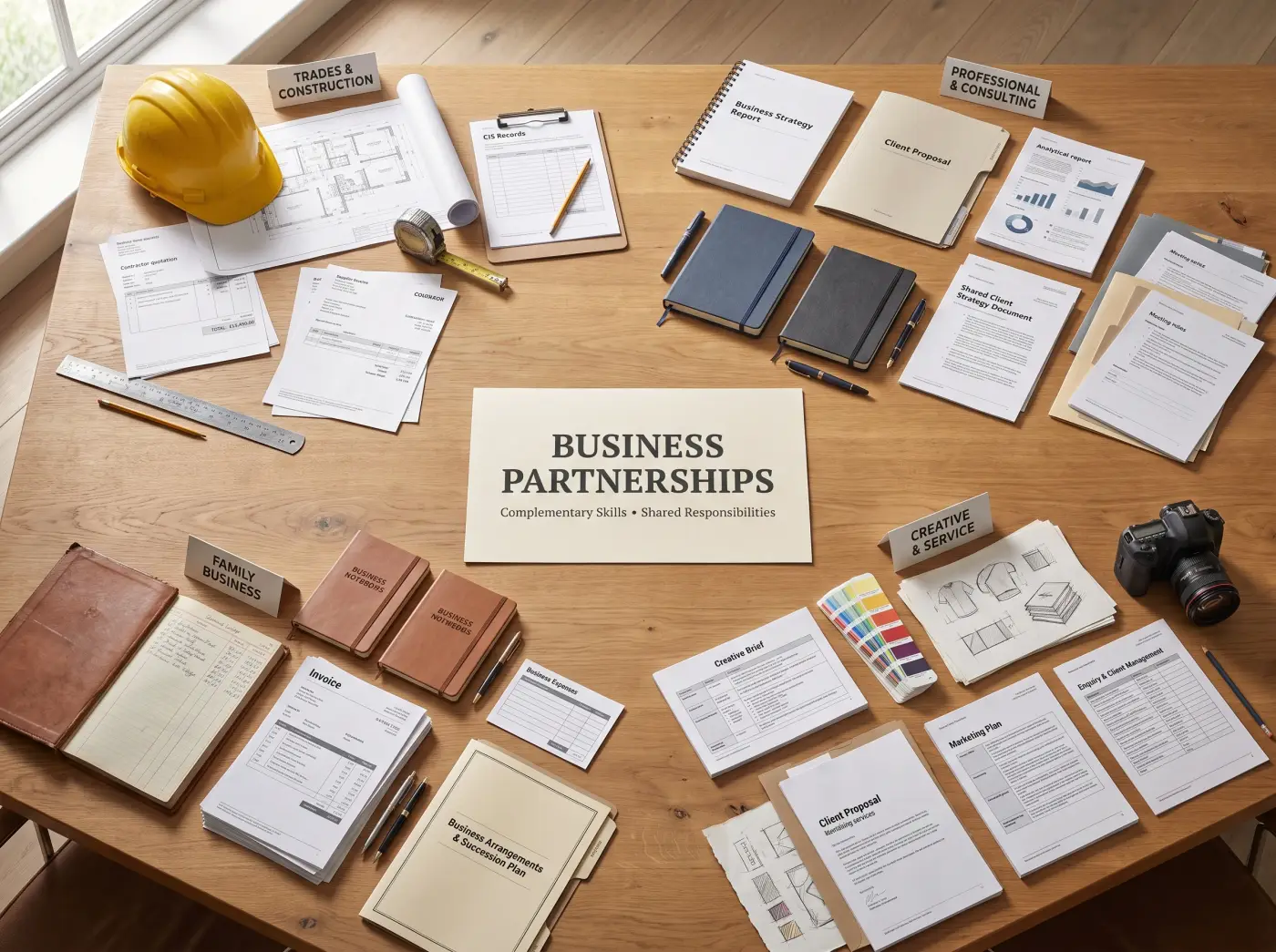
Examples of Businesses That Can Work Well as Partnerships
(For Illustrative Purposes Only)
There is no particular industry that must operate as a partnership.
But the structure can work naturally where two or more owners contribute complementary skills.
Trades and Construction Businesses
One partner may handle technical delivery and site management while another deals with quotes, customers, suppliers and administration.
For construction businesses, additional obligations such as the Construction Industry Scheme (CIS) may also need to be considered.
KG Business Services provides CIS support alongside bookkeeping and wider accounting services.
Professional and Consulting Businesses
Consultants with complementary expertise may combine their client bases and experience under one business.
The partnership structure can work particularly well when both individuals actively contribute to delivering the service.
Family Businesses
Partners who already have a strong working relationship may choose to operate a family business together.
That familiarity can be useful.
It should not replace formal financial arrangements.
In fact, clear arrangements matter even more when family relationships are involved.
Creative and Service Businesses
Agencies and service businesses can also suit partnerships.
One person may concentrate on service delivery while another handles client acquisition and commercial management.
Again, structure should follow the reality of the business rather than the industry label.
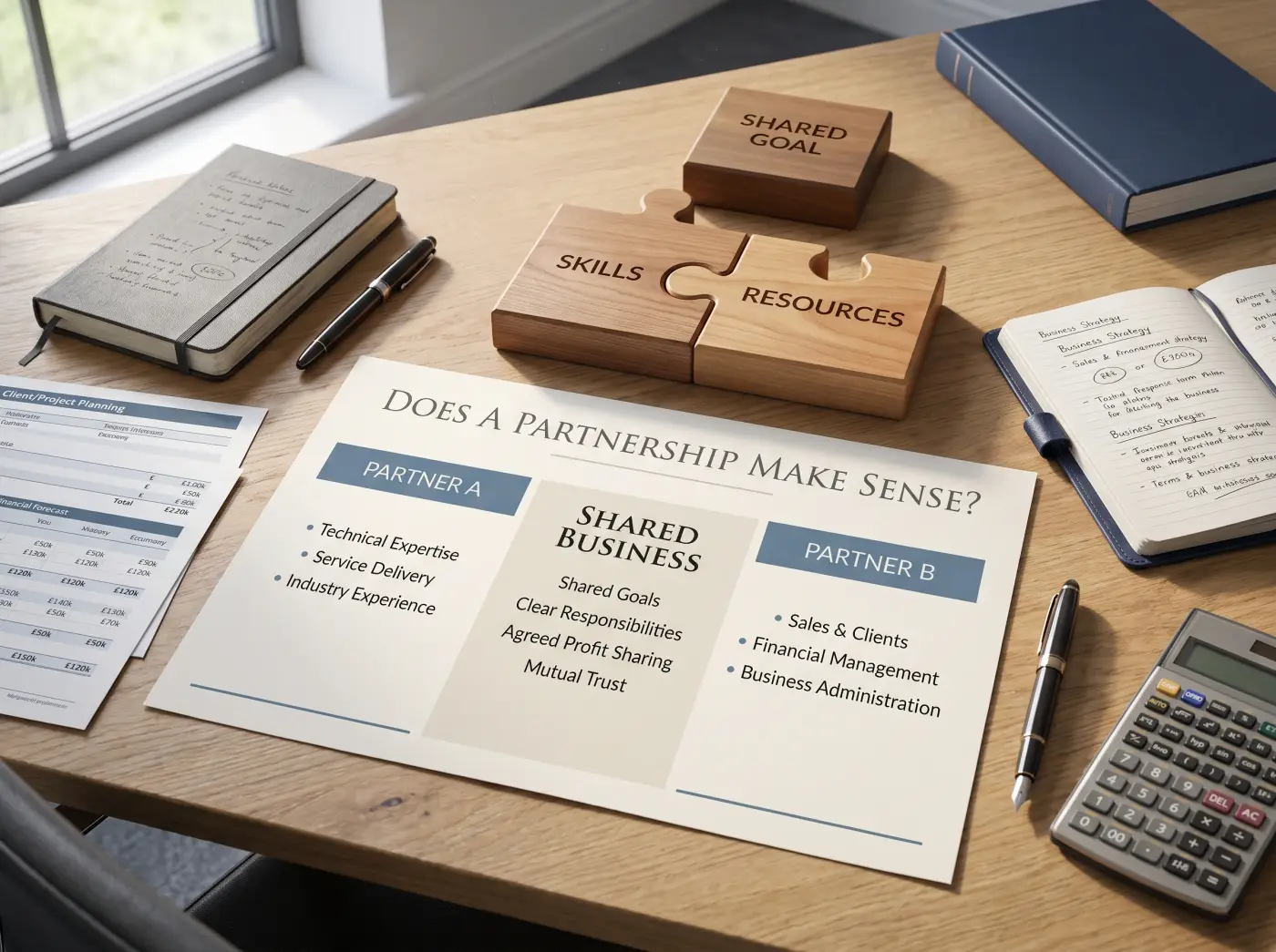
When Does a Partnership Make Sense?
(For Illustrative Purposes Only)
A partnership may be worth considering when:
- You genuinely want to build the business together.
- You trust the other partner’s judgement.
- Your skills complement each other.
- You are comfortable sharing profits.
- You can agree how major decisions will be made.
- You understand the liability involved.
- You want a relatively straightforward owner-managed structure.
- Your long-term growth plans suit the partnership model.
There is one thing I would add to that list:
You should be able to have uncomfortable conversations with your partner.
If you cannot discuss money, workload, ownership and what happens if somebody wants out before starting the business, those conversations are unlikely to become easier once substantial money is involved.
When Might a Partnership Be the Wrong Choice?
I would look carefully at alternatives if:
- Limiting personal financial exposure is a major priority;
- You expect to bring in substantial external equity investment;
- You want complete individual control;
- You and the proposed partner have very different financial expectations;
- One person will do most of the work but profits will be split equally;
- Ownership is likely to change frequently;
- You are already planning a rapid scale-up; or
- Neither partner wants responsibility for the financial administration.
Sometimes the right advice is not:
“How do we set up the partnership?”
It is:
“Should this actually be a partnership?”
That question can save an enormous amount of trouble later.
The Partnership Decision I Would Make Before Anything Else

(For Illustrative Purposes Only)
If we were sitting down with two people considering starting a business together, We would not begin by asking which accounting software they want.
We would ask:
What do you both want this business to become?
If one person wants a comfortable owner-managed business and the other wants to grow rapidly, take on investment and sell in five years, you already have something important to resolve.
Then we would want to know:
How will you divide responsibilities?
How will you share profits?
What happens when one person wants more money out of the business?
How much risk are you prepared to accept?
What happens if one of you wants to leave?
Only then does the technical structure really make sense.
The best business structure is not necessarily the cheapest or easiest one to establish today.
It is the one that supports where you are trying to go.
Starting or Running a Partnership? Get the Financial Side Right
A partnership can be a brilliant way to build a business.
You can share the pressure, combine expertise and build something stronger together.
But good partnerships need more than trust.
They need clear responsibilities, accurate records and a financial setup that both partners understand.
That is where KG Business Services Ltd can help.
Based in Clydebank, we work with startups and small and medium-sized businesses, providing practical support with bookkeeping, self-assessment, VAT returns, payroll, CIS, Making Tax Digital and wider accounting requirements.
We are not interested in making your accounts sound more complicated than they need to be.
The aim is much simpler:
Keep the numbers organised, keep your obligations under control and give you more time to run the business.
If you are starting a partnership or already running one and the financial administration is beginning to take over your week, speak to the KG Business Services team about the accounting support your business actually needs.
Speak to KG Business Services.
Frequently Asked Questions About Business Partnerships
What is a partnership in business?
A partnership is a business structure in which two or more people operate a business together. In an ordinary UK partnership, partners share responsibility for the business and each partner generally pays tax on their share of its profits.
What are the main advantages of a partnership?
The main advantages of a partnership include shared workload, combined skills, access to more resources, shared decision-making, flexible management and fewer corporate formalities than running a limited company.
What are the main disadvantages of a partnership?
Important partnership disadvantages include personal liability, sharing profits, potential disagreements, reduced individual control, difficulties when a partner leaves and possible limitations when seeking substantial external investment.
Are business partners personally responsible for debts?
In an ordinary partnership, partners can have personal responsibility for business debts and losses. Scottish partnerships have separate legal personality, but partners can still become personally liable where the partnership’s assets are insufficient to meet its debts.
How are partnership profits taxed?
The partnership calculates and reports its profits, and the profits are allocated between the partners. Each partner generally reports their share through their individual self-assessment tax return and pays tax according to their circumstances.
Does a partnership need to register with Companies House?
An ordinary business partnership generally does not register with Companies House in the same way as a limited company. Different rules apply to limited partnerships and LLPs.
Does a partnership need a partnership agreement?
A written agreement is strongly advisable. It can document profit sharing, capital contributions, decision-making, responsibilities, the admission of new partners, exits and dispute procedures. Legal advice should be sought when preparing the agreement.
Can two people start a partnership?
Yes. An ordinary partnership can be established by two people running a business together. Partnerships can also contain more than two partners.
Is a partnership better than being a sole trader?
Neither is automatically better. A sole trader retains individual control, while a partnership allows two or more owners to combine skills, capital and responsibilities. The right choice depends on ownership, risk, tax and future business plans.
Is a partnership better than a limited company?
It depends on the business. Partnerships can offer simpler administration, while limited companies normally provide greater separation between the business and its owners and may be more suitable for certain growth or investment plans. Tax should also be considered using the actual circumstances rather than general assumptions.
Can KG Business Services help with partnership accounts?
KG Business Services supports partnerships and small businesses with services including bookkeeping, self-assessment, VAT returns, payroll, CIS and Making Tax Digital. The team can help keep financial records and ongoing accounting obligations organised, while legal matters such as drafting a partnership agreement should be handled by an appropriate legal professional.