A public limited company (PLC) is a legal structure that permits you to offer shares to the general public, though it is not automatically listed on a stock exchange. This business structure brings unique benefits and challenges that can really shape your company’s future.
Understanding these factors is essential before you decide to take your company public.
A Quick Overview of Public Limited Companies
Defining What a Public Limited Company (PLC) Is and Its Legal Structure
A public limited company is a business entity registered under company law that is legally permitted to offer shares to the public. If the company chooses to float, these shares can be traded publicly on stock exchanges. You can spot these companies by the “PLC” designation after their name.
The legal structure requires at least two directors and two shareholders, but there’s no upper limit. You’ll also need a qualified company secretary who understands the legal responsibilities involved.
Your company needs at least £50,000 in share capital before you can trade, with 25% of this paid up before registration. As a PLC, you operate as a separate legal entity from your shareholders.
This means your company can own property, enter contracts, and face legal action in its own name. Shareholders enjoy limited liability, which protects their personal assets beyond their shareholding.
The structure demands strict compliance with financial reporting standards and regulatory oversight. You must publish annual accounts and make them available to the public.
The Companies Act governs your operations and sets out specific duties for your directors and requirements for shareholder meetings.
Understanding the Advantages of Public Limited Companies
Public limited companies offer several key benefits that make them attractive to growing businesses. These advantages include better access to funding, stronger market reputation, improved ability to hire skilled workers, and greater potential for business expansion.
Access to Capital Through Public Share Offerings

(For Illustrative Purposes Only)
The primary advantage of a public limited company is the ability to raise substantial capital by selling shares to the general public. When your company goes public on a stock exchange, you can reach thousands of potential investors who might purchase shares in your business.
This access to public markets means you aren’t limited to loans from banks or investments from a small group of private investors. You can raise millions or even billions of pounds depending on investor interest and market conditions.
Enhanced Business Credibility

(For Illustrative Purposes Only)
Being a public limited company gives your organisation stature. With a PLC designation, your organisation has met the criteria for compliance, and your business has the continual scrutiny.
The law demands that public companies disclose financial information that any stakeholder can access. This builds people’s confidence.
Because your financial position is a public document, the bank and suppliers are likely to offer a PLC better financial assistance. Your standing when bidding for a large business is also persuasive.
Public companies have the confidence and stability to carry out large project work, which is why government and large-scale private companies are far more willing to engage with them. This allows public companies to take on work that private companies cannot do.
Ability to Attract and Retain Talent
PLCs have distinct advantages when recruiting and keeping talented employees. You can offer share options and equity-based compensation packages that give workers direct ownership in the company.
These schemes allow employees to benefit financially as the company grows and succeeds. The prestige of working for a publicly listed company also appeals to top professionals.
Many skilled workers prefer PLCs because they offer better job security and clearer career advancement paths. Your company’s public profile makes it easier to advertise positions and attract candidates.
Share incentive programmes align employee interests with company performance. When workers own shares, they have personal motivation to help the business succeed.
Opportunities for Growth and Expansion
Business growth is possible through two components: access to capital and credibility. Share capital enables the acquisition of other businesses, geographical diversification, or product development.
Publicly listed companies (PLCs) have more acquisition options, as payment can be made in shares rather than cash. This is called share-based payment and allows your company to pursue aggressive growth strategies that are not possible with a private company.
Your public company shares are an excellent asset for acquisition purposes. Being a PLC increases the visibility of your company and attracts interest, which facilitates potential collaborations with more influential companies.
Some Financial Advantages of Public Limited Companies

(For Illustrative Purposes Only)
Wider Access to Investment
When you form a public limited company, you can sell shares to the general public through stock exchanges. This opens up a vast pool of potential investors beyond just banks and private equity firms.
You can raise substantial amounts of capital quickly by issuing new shares. Unlike private companies that rely on a small group of shareholders or loans, PLCs can attract thousands of individual and institutional investors.
This makes it easier to fund major projects, research and development, or business expansion. The ability to raise capital through public offerings also means you face fewer restrictions on how much money you can gather.
Share Liquidity and Marketability

(For Illustrative Purposes Only)
Your shares become easily tradable when listed on a stock exchange. Investors can buy and sell shares quickly during trading hours, which makes your company more attractive to potential shareholders.
This liquidity provides flexibility for both you and your investors. Shareholders can exit their investment whenever they choose without needing approval from other owners.
This ease of trading often increases demand for your shares and can push up their value. Share marketability also helps you use shares as a currency.
Economies of Scale
Having access to more money means you can expand your business more easily. With your business expanding, the costs involved will decrease, resulting in higher profits.
You can also afford to buy better technology, implement automated processes, and take advantage of bulk purchasing, which smaller companies cannot afford. It may cost more initially, but it will lower your long-term business costs.
You will also be able to negotiate better with your customers and suppliers. You will be able to get better payment terms, discounts for buying in large quantities, and more favourable contracts that will improve your financial circumstances.
Examining the Disadvantages of Public Limited Companies
Greater Regulatory and Reporting Obligations

(For Illustrative Purposes Only)
As a public limited company, there are several guidelines that you must adhere to that require ongoing compliance and reporting to various governing agencies. Listed PLCs must report their financial performance to the public, typically through comprehensive Annual Reports and Half-Yearly interim results, overseen by regulators like the Financial Conduct Authority (FCA).
Your company will spend a lot of time and money on compliance reporting. You will need to hire several employees exclusively to ensure that your company complies, as well as some accountants to do the same.
While a PLC is legally allowed to offer shares to the general public, it is not automatically listed on a stock exchange. If you choose to float your PLC on a stock market (like the London Stock Exchange), you will face high costs to maintain that listing and ensure high share liquidity.
You are required to tell the public about your business and its operations. You will lose your trade secrets and be forced to divulge your financial information, your detailed plans and strategies, and operational information that your competitors do not have.
Vulnerability to Market Fluctuations
Your share price changes based on market conditions and investor sentiment. These fluctuations happen even when your business performs well.
External factors like economic downturns or industry trends affect your company’s valuation daily. Short-term investors often pressure you to focus on immediate profits rather than long-term growth.
They may sell shares quickly if results disappoint, causing your stock price to drop sharply. This volatility makes financial planning more difficult for your organisation.
Dilution of Ownership and Control

(For Illustrative Purposes Only)
You lose ownership percentage when public investors buy into the company. Founders and early shareholders experience the most dilution.
Your voice is diminished in important decisions as you lose ownership. The company becomes accountable to a board and shareholders.
Your priorities may not align with those of these stakeholders. The need for their consent to make decisions can hamper your operational agility.
With the interests of different shareholders to consider, the decision-making process gets more complicated. Large institutional investors, in particular, tend to have their own preferred directions and may even assert those.
Some Operational and Management Challenges

(For Illustrative Purposes Only)
Complex Decision-Making Processes
When functioning as a public limited company, your decision-making processes become slower and more complex. You have to meet with a board of directors, receive shareholder approval for large-scale decisions, and deal with numerous layers of a management structure.
Shareholders can vote regarding company mergers, acquisitions, and structural reorganisations. As a result, you cannot respond quickly to opportunities that are time-sensitive.
There are also others involved. These create competing interests. Board meetings usually have advance notice and formal voting. There are also quorum requirements.
Potential for Hostile Takeovers

(For Illustrative Purposes Only)
Your company becomes vulnerable to hostile takeovers once shares trade publicly on the stock exchange. Any investor or rival company can purchase shares on the open market and attempt to gain a controlling interest without your approval.
Hostile bidders can slowly and secretly buy up stock, which can make it difficult to defend against hostile takeovers. You might be offered a hostile takeover, which could be financially beneficial to shareholders but would be against your strategic vision as a company.
If the party seeking to acquire the company has enough of a stockholder voting bloc, they can vote out the corporate management team and replace it with people of their choosing. Comprehensive takeover defences can be extremely costly and also shift the focus of the company.
Heightened Transparency Requirements
You are legally obligated to provide the public with your financial and operational data regularly. This includes the annual reports and half-yearly interim reports you are required to submit as well as the reports you must submit to the public when any significant changes impact the value of your shares.
The requirement for transparency does not end with financial statements. You are required to disclose information about executive pay, significant shareholders, and detailed descriptions of business risks.
Unlike private businesses, which can keep their strategies confidential, your competitors are able to see your business strategies. Your adherence to the requirements of disclosure is supervised by the regulators, such as the Financial Conduct Authority.
| Advantages of a PLC | Disadvantages of a PLC |
|---|---|
| Access to large capital – Can raise funds by selling shares to the public. | High regulatory burden – Must follow strict legal and reporting requirements. |
| Limited liability – Shareholders’ personal assets are protected. | Costly to set up and maintain – includes legal and compliance costs. |
| Enhanced credibility – Builds trust with investors and clients. | Loss of privacy – Financial details must be publicly disclosed. |
| Potential for share liquidity – If floated on an exchange, shares can be easily bought and sold. | Vulnerability to market fluctuations – Share prices can change frequently. |
| Attracts top talent – Can offer share-based incentives. | Dilution of ownership – Founders may lose control. |
| Growth opportunities – Easier expansion and acquisitions. | Complex decision-making – Requires approvals from shareholders. |
| Economies of scale – Reduced costs with business growth. | Risk of hostile takeovers – Others can buy controlling shares. |
| Better financing options – Easier access to loans and investment. | Short-term pressure – Focus on quick profits from investors. |
Comparison with Other Business Structures

(For Illustrative Purposes Only)
Public Limited Company vs Private Limited Company
Limited liability protection is a feature of both private limited companies and PLCs. This means that in the case of a business debt, your personal assets are protected.
However, this is where the differences start. With PLCs, you can trade shares publicly on open stock exchanges. Unlike this, private limited companies have a lot of restrictions when it comes to shares. They cannot trade shares publicly and have limitations in the buying and selling of shares.
PLCs need at least £50,000 in share capital, and you have to pay up at least 25% before trading. Private limited companies? No minimum capital required.
You also need at least two directors for a PLC, compared to just one for a private limited company.
The governance structure is stricter for PLCs. You must appoint a qualified company secretary, which is only optional for private companies.
Public Limited Company vs Partnership

(For Illustrative Purposes Only)
Partnerships don’t offer limited liability protection, unless you form a limited liability partnership (LLP). In a traditional partnership, you become personally liable for all business debts and obligations.
This puts your personal assets at risk if the business fails.
PLCs make it much easier to raise capital by selling shares to public investors. Partnerships depend on partner contributions and bank loans, which limit growth.
PLCs keep running regardless of shareholder changes. Partnerships can dissolve when partners leave or die, which creates continuity headaches.
Public Limited Company vs Sole Trader
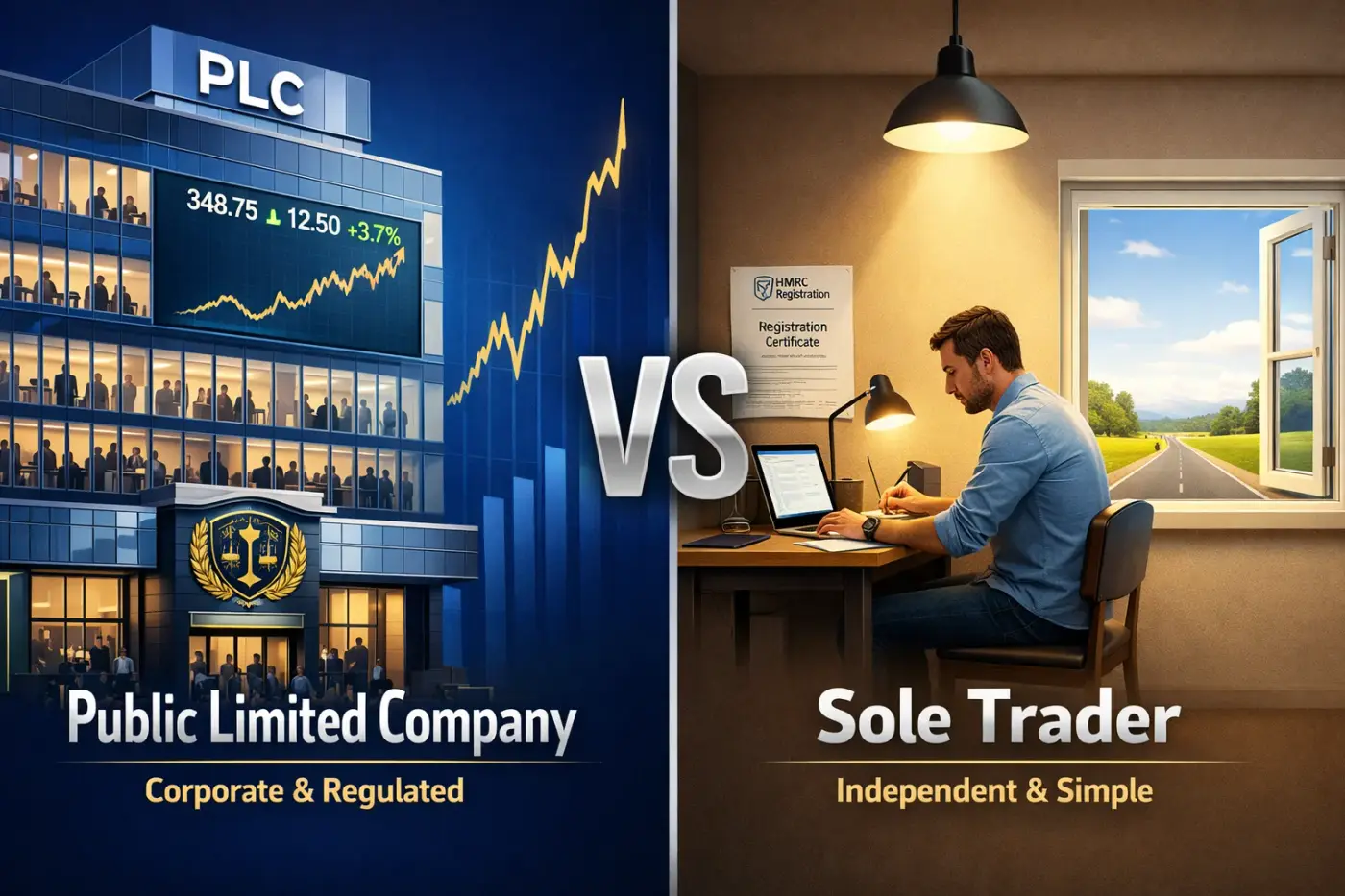
(For Illustrative Purposes Only)
Unlimited liability means that sole traders are liable for all debts of the business. This means that if things go wrong, you are financially liable, which can hurt your home, savings, and possessions.
This risk is eliminated with PLCs.
Starting as a sole trader is quite straightforward and inexpensive. You just need to register with HMRC, and you can start.
This is in contrast to PLCs, which require a lot more in terms of initial legal costs as well as costs of compliance on a regular basis.
Being a sole trader means you can make all the decisions. You won’t have to consult anyone else.
Frequently Asked Questions
How does a public limited company raise capital, and what are the trade-offs?
An Initial Public Offering (IPO) is your first chance to raise funds by selling shares to the general public for the first time. This is an extensive process that requires the coordination of underwriters, legal advisors, and financial auditors, incurring costs of several million.
After an IPO, you are allowed to issue additional shares to raise further capital. Be aware, however, that each new share offered to the public will dilute the percentage of ownership of existing shareholders.
The price at which your shares are trading will influence your ability to raise funds.
What legal and reporting obligations must a public limited company comply with in the UK?
You must file annual accounts with Companies House within six months of your financial year-end. These accounts always need an independent audit, no matter the size of your company.
You have to publish interim financial statements every six months. Listed companies must announce price-sensitive information right away through regulatory news services.
Your company needs at least £50,000 in share capital, with 25% paid up before trading. The company name must end with “Public Limited Company” or “PLC”.
How does shareholder ownership affect control and decision-making in a public limited company?
The shareholders are the owners of the firm; however, they do not manage its day-to-day activities. Instead, they elect board members, who, in turn, supervise the management and represent them in making decisions about the company.
At general meetings, shareholders must approve big decisions. These can include the appointment of directors, payment of dividends, and alterations to the company’s constitution.
Major institutional investors control a substantial portion of the company’s votes. If the members of your board of directors do not propose a decision that the pension fund or the investment management company supports, they may prevent or support a decision.
What are some well-known examples of public limited companies, and what do they illustrate about this structure?
Tesco PLC shows how public listing lets a company expand quickly, thanks to easier access to capital. The supermarket chain often invests in new stores and technology, always trying to stay ahead.
British Airways PLC, now part of IAG, highlights how airlines tap into public markets to buy expensive aircraft. Capital-intensive industries like this one can spread their financial risk among thousands of investors.
Marks & Spencer PLC faces real pressure as a public company, especially during tough trading periods. Its share price moves up or down based on what the public thinks about the retailer’s performance and strategy.
Rolls-Royce Holdings PLC is a good example from the engineering sector. This company uses public markets to fund long-term industrial projects, balancing shareholder expectations with development cycles that can take years.