Every UK limited company needs to prepare and file one annually with Companies House. The statement of financial position reveals your company’s complete financial health by listing your assets, liabilities, and equity in a legally compliant format.
Whether you’re a new director filing your first accounts or an established business owner reviewing your financial standing, understanding this document is essential.
It affects your ability to secure funding, satisfy regulatory requirements, and make informed business decisions.
This guide covers everything you need to know about creating and filing your statement of financial position in the UK.
You’ll learn the proper FRS 102 format for 2026 and how to avoid common mistakes that lead to rejected filings.
Essential Definitions and Concepts

(For Illustrative Purposes Only)
What Is a Statement of Financial Position?
A statement of financial position reports your company’s assets, liabilities, and equity on a specific date. It provides a snapshot of your business’s financial health at that exact moment.
The document lists three main categories. Assets are the resources your business owns, such as cash, equipment, and property.
Liabilities are what your business owes to others, including loans and unpaid bills. Equity represents the owner’s stake in the business after subtracting liabilities from assets.
The statement follows a simple formula: Assets = Liabilities + Equity. This equation needs to balance, which is why the document is also called a balance sheet.
Statement of Financial Position vs Balance Sheet

(For Illustrative Purposes Only)
The terms “statement of financial position” and “balance sheet” refer to the same financial document. There isn’t any difference in their meaning or content.
The term “balance sheet” has been used in accounting for decades. The phrase “statement of financial position” is the modern, formal name preferred in current accounting standards.
UK businesses use both terms interchangeably. You’ll see “balance sheet” more often in everyday business conversations, but formal financial reporting and accounting qualifications typically use “statement of financial position”.
Why UK Businesses Need This Document
UK limited companies must prepare a statement of financial position as a legal requirement each year. Companies House requires you to file this document as part of your annual accounts.
The statement helps you monitor your business performance and financial health. You can see whether your assets are growing and if your debts are manageable.
Banks and investors check this document when considering whether to lend money or invest in your business. HMRC uses your statement of financial position to verify information on your tax returns.
The document also helps you identify potential cash flow problems before they become serious.
UK Statement of Financial Position Format (FRS 102 2026)
Official UK GAAP Structure Under FRS 102

(For Illustrative Purposes Only)
FRS 102 permits two presentation formats for your statement of financial position: the vertical format and the statutory format prescribed by the Companies Act 2006. Most UK entities use the vertical format, which lists assets first, followed by liabilities, with net assets reconciling to total equity.
The standard requires you to classify your assets as either non-current or current based on your operating cycle or 12 months. Non-current assets include property, plant and equipment, intangible assets, and investments.
Current assets cover inventory, trade debtors, and cash. Your liabilities must follow the same classification approach.
You separate amounts falling due within one year from those due after more than one year. This distinction helps users assess your short-term liquidity and long-term solvency.
You must present prior-year comparatives for all figures shown on your statement of financial position. This allows readers to identify trends and changes in your financial position between periods.
Layout and Statutory Requirements
The Companies Act 2006 sets out two prescribed balance sheet formats. Format 1 presents items in list form (the vertical approach), while Format 2 uses a two-sided account format.
You can choose either format, but Format 1 is standard practice across UK businesses. Your statement must show specific line items as a minimum requirement:
- Fixed assets (split between intangible and tangible)
- Current assets (inventory, debtors, investments, and cash)
- Creditors due within one year
- Net current assets or liabilities
- Total assets less current liabilities
- Creditors due after more than one year
- Provisions for liabilities
- Capital and reserves
You need to aggregate items on the face of the statement but provide detailed breakdowns in your notes to the accounts. The Companies Act 2006 specifies which items you can combine and which require separate disclosure.
Abridged, Filleted, and Micro-Entity Accounts
Historically, qualifying small and micro-companies could file ‘abridged’ or ‘filleted’ accounts, which allowed them to omit their profit-and-loss account from the public register.
However, under the Economic Crime and Corporate Transparency Act (ECCTA), these exemptions are being abolished.
Going forward, small and micro-entities will be required to file their Profit and Loss accounts with Companies House to improve corporate transparency.
Micro-entities applying FRS 105 use the most simplified format.
Your statement shows only broad categories: fixed assets, current assets, liabilities, and capital. You don’t need to distinguish between amounts due within or after one year for creditors.
Small companies using FRS 102 Section 1A follow a reduced disclosure framework.
2026 UK Accounting Standard Changes You Must Know
The Periodic Review 2024 amendments to FRS 102 apply to accounting periods beginning on or after 1 January 2026. Early application is permitted if you adopt all amendments simultaneously.
The amendments introduce new disclosure requirements for supply chain finance arrangements. You must now provide information about these arrangements in your notes, including their nature and the carrying amount of related liabilities on your statement of financial position.
Revenue recognition rules have undergone major updates affecting how you present related assets and liabilities.
Contract assets and contract liabilities now require separate presentation on your statement of financial position rather than being included within debtors or creditors.
Lease accounting changes mean you now recognise most leases on your statement of financial position.
You must show right-of-use assets separately from owned assets and lease liabilities distinct from other financial obligations.
This significantly affects entities with substantial operating lease commitments under the previous standard. The amendments also clarify presentation requirements for financial instruments and fair value measurements.
You need to ensure your statement of financial position reflects these updated classification and measurement principles from 1 January 2026 onwards.
Detailed Breakdown of Components

(For Illustrative Purposes Only)
Assets: Current, Non-Current, and Intangible
Current assets are resources your business expects to convert into cash within 12 months. These include cash and cash equivalents, which represent your most liquid funds available for immediate use.
Trade debtors (also called receivables) show the money customers owe you for goods or services already delivered. Your inventory or stock represents products held for sale, whilst prepayments reflect expenses paid in advance for future benefits.
Non-current assets (sometimes called fixed assets) are long-term resources that support your business operations beyond one year. The most common category is property, plant and equipment, which covers buildings, machinery, vehicles, and office equipment.
These assets appear at their original cost minus accumulated depreciation. Intangible assets are non-physical resources with economic value, like patents, trademarks, software licences, and goodwill from acquisitions.
Right-of-use assets show up when your company holds long-term leases, as these on-balance-sheet leases must be recorded under current accounting standards. All intangible assets need regular review for impairment.
Liabilities: Current and Non-Current
Current liabilities are obligations your business must settle within one year. Trade creditors (or payables) represent amounts you owe suppliers for goods or services received.
Accruals account for expenses incurred but not yet invoiced, such as utility bills or wages. You might also see this section labelled as ‘creditors: amounts falling due within one year’ on some statements.
Short-term borrowings, tax obligations, and the current portion of long-term debt also fall under current liabilities. These items need careful monitoring as they directly impact your working capital and cash flow position.
Non-current liabilities are obligations due after more than 12 months. These typically include long-term loans, mortgages, and bonds.
Lease liabilities appear here for leases extending beyond one year, matching the right-of-use assets on the other side of the statement.
Deferred tax represents tax obligations that won’t be paid until future periods, arising from timing differences between accounting and tax rules.
Equity, Capital, and Reserves
Shareholders’ equity (also called owners’ equity or shareholders’ funds) represents the residual interest in your company after deducting all liabilities from assets. This section shows what belongs to the business owners.
Share capital (or called-up share capital) reflects the nominal value of shares issued to shareholders. This figure only changes when you issue new shares or buy back existing ones.
It forms the permanent capital base of your limited company. Retained earnings accumulate all profits your business has kept since formation, minus any dividends paid to shareholders.
This figure grows when your company makes profits and shrinks when you distribute dividends or incur losses. Together, share capital and retained earnings make up your capital and reserves.
Underlying Accounting Principles
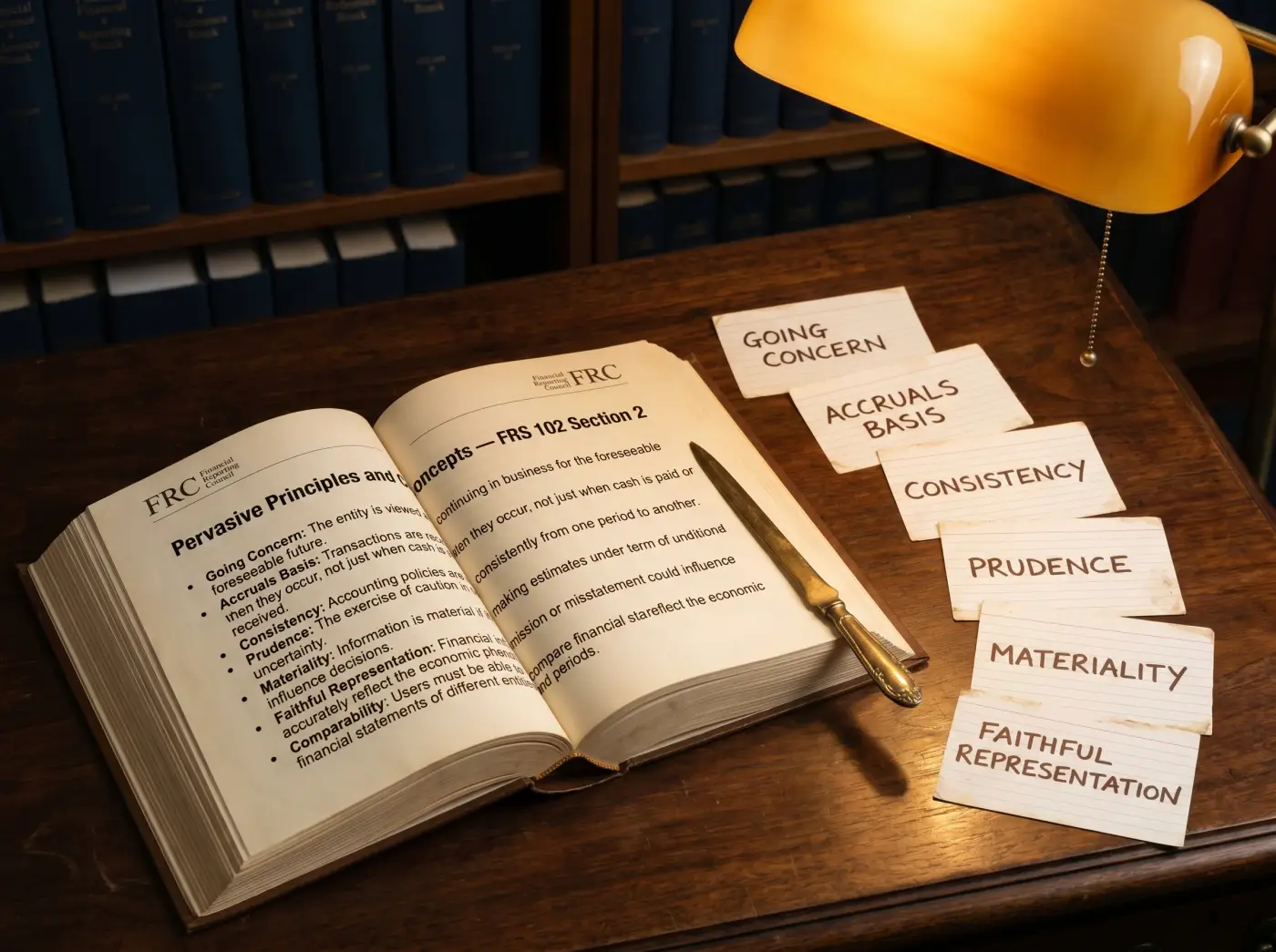
(For Illustrative Purposes Only)
The Accounting Equation and Net Assets
The accounting equation forms the foundation of your statement of financial position. This equation states that assets equal liabilities plus equity.
Everything your business owns must be balanced by what it owes to creditors and what belongs to the owners. You can rearrange this equation to calculate your net assets.
Net assets represent assets minus liabilities, which equals your total equity. This figure shows the true value that belongs to your business owners after all debts are paid.
Your capital and reserves section reflects this net asset position. It includes share capital, retained earnings, and other reserves.
Statement of Financial Position Formula
The core formula shapes your whole statement: Total Assets = Total Liabilities + Total Equity. You put all assets on one side and then list liabilities plus equity on the other.
Assets cover current things like cash and stock, as well as non-current items like property and equipment. Liabilities break down into current (due within a year) and non-current (due later).
The equity section reveals what’s left for the owners. Under FRS 102, you can lay out this formula in different ways.
Reconciling and Adjusting Balances
You need to reconcile your bank accounts before you finalise your statement of financial position. This means matching your records to the bank’s and hunting down any differences.
Unrecorded transactions or timing differences? You’ll need to post adjustment entries for those. Year-end adjustments make sure all balances show the real values.
Record depreciation on fixed assets to reflect how they lose value over time. This spreads out the cost of assets over their useful lives.
Other adjustments include accruals for expenses you’ve incurred but haven’t paid, and prepayments for costs you’ve paid in advance.
Presentation, Preparation, and Filing Requirements
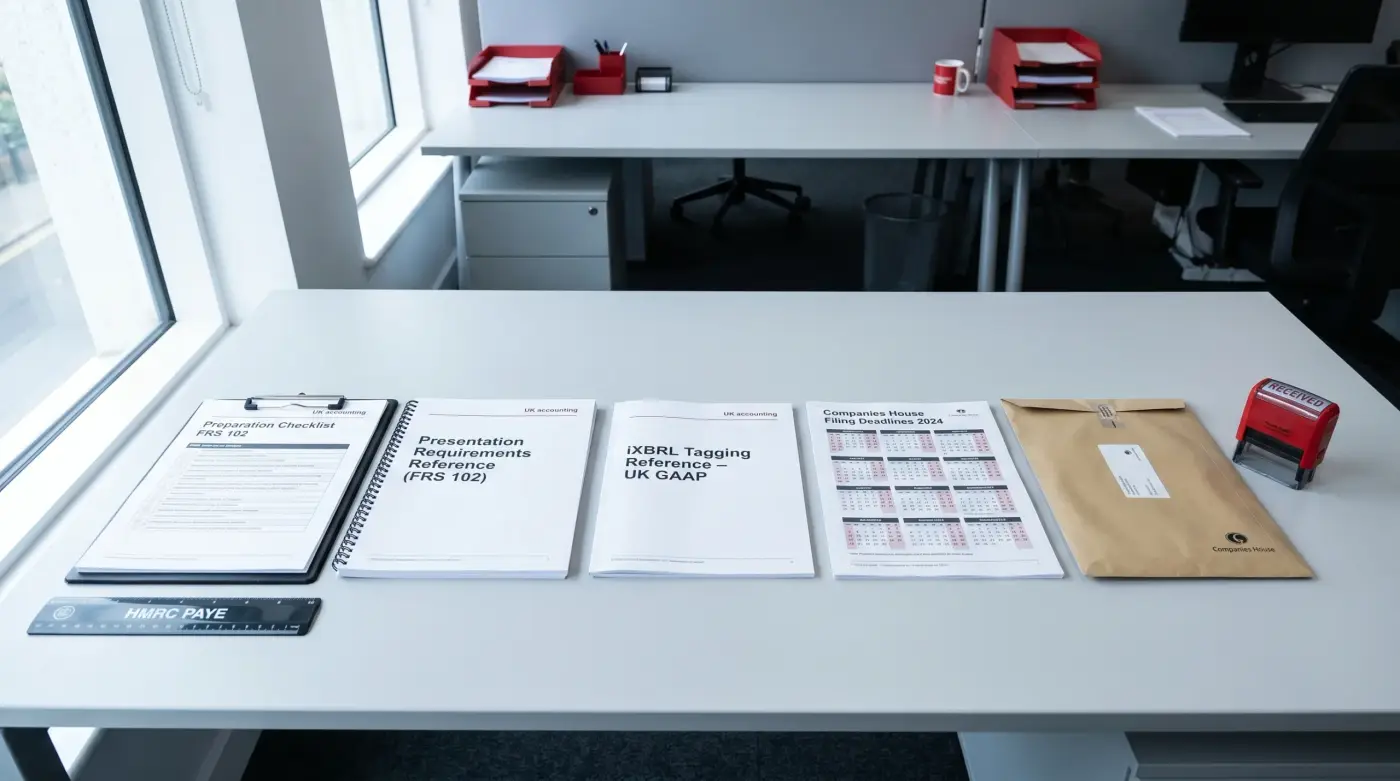
(For Illustrative Purposes Only)
How to Prepare and Make a Statement of Financial Position
Start with your company’s trial balance, which lists all account balances at the end of the period. That’s your raw data for the statement.
Your statement has to include certain line items grouped into categories. Assets go first, split between non-current (property, equipment) and current (inventory, cash).
Liabilities come next, divided into current (due within 12 months) and non-current (due after 12 months). Equity comes last, showing things like share capital and retained earnings.
The basic equation always needs to balance: Assets = Liabilities + Equity. Use the FRS 102 or FRS 105 format, depending on your company’s size.
By law under the Companies Act 2006, your finalised Statement of Financial Position must be approved by the board of directors and signed by at least one director (with their name printed) before it can be filed.
Templates and Example Statements
Companies House doesn’t hand out official templates, but accounting software and professional bodies offer sample statements. These examples show the right format and line items for different company sizes.
A typical example puts fixed assets at the top, then current assets, followed by creditors due within a year. You’ll see net current assets, total assets less current liabilities, creditors due after more than a year, and, finally, capital and reserves.
You can grab templates from your accounting software provider or get examples from your accountant. The template you use should match your company type: micro-entity, small, or large.
Software, Digital Filing, and Making Tax Digital
You can file your annual accounts online using Companies House WebFiling or commercial software. Xero and similar platforms will generate your statement of financial position straight from your bookkeeping data.
Making Tax Digital rules apply to VAT and income tax, but not yet to Companies House filings. Still, using cloud accounting software gets you ready for future digital changes.
Most software lets you file statutory accounts directly to Companies House. If you file late, you’ll face automatic penalties starting at £150 for private companies.
Common Statement of Financial Position Mistakes (UK)
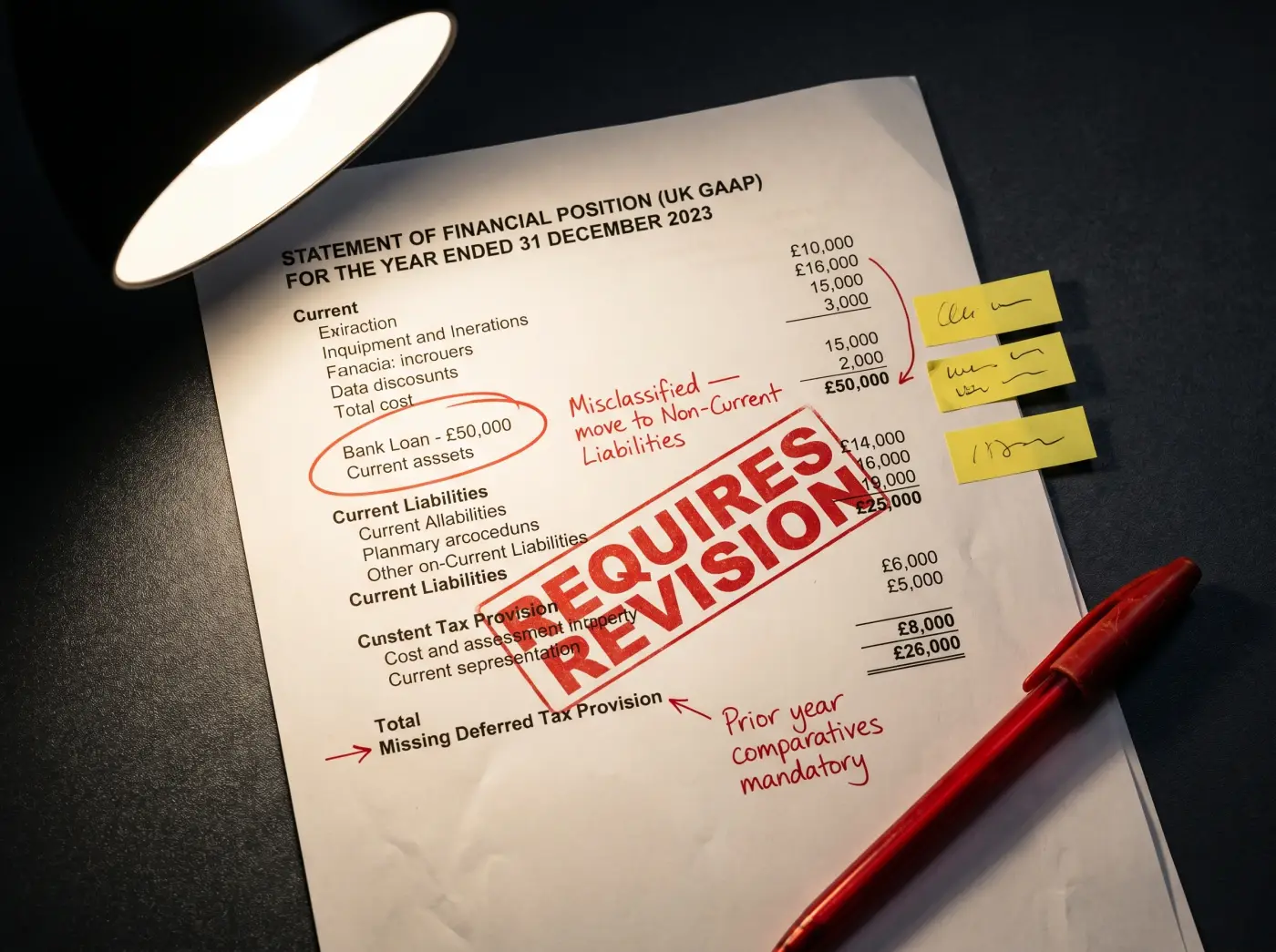
(For Illustrative Purposes Only)
Mistake 1: Not Updating Asset Values
Fixed assets, like equipment, vehicles, and property, need regular depreciation to show their actual value. If you skip this, your balance sheet overstates what you own.
Many companies buy assets and record them at cost, but then forget to knock down their value over time. That inflates total assets and throws off key ratios, like the gearing ratio, when investors or lenders check your financials.
You’ve got to use the right depreciation method for each asset’s useful life. For example, a delivery van worth £20,000 and a five-year life should drop by about £4,000 a year using straight-line depreciation.
Your balance sheet should show both the original cost and the accumulated depreciation. Revaluation matters too, especially for property. If your property’s gone up in value, UK GAAP lets you revalue, but you need to do it consistently and mention it in your notes.
Mistake 2: Missing Current Liabilities
Current liabilities are debts due within 12 months. Leaving them off your statement creates real trouble, making your business look healthier than it is and misleading anyone reading the balance sheet.
People often forget items like accrued expenses, tax liabilities, and the current part of long-term loans. If you’ve got a five-year loan, whatever’s due in the next 12 months should go under current liabilities, not just non-current.
Missing these distorts your working capital calculation. Working capital equals current assets minus current liabilities, and it shows if you can meet short-term obligations.
Mistake 3: Incorrect Liquidity Order
UK accounting standards set a specific order for assets and liabilities on your statement. Assets should be listed from least liquid to most liquid, or the other way around, depending on your chosen format.
The usual UK format lists fixed assets first, then current assets. Inside current assets, you’ll see stock (inventory), debtors (receivables), and then cash. This order helps readers see how fast you can turn assets into cash.
Some businesses mix up this order or lump items together incorrectly. Cash and bank balances should be the most liquid current assets, with debtors next (since you expect payment soon), and stock before debtors (since you need to sell it first).
Mistake 4: Not Separating Current vs. Non-Current
Mixing up current and non-current items is one of the most common errors. It really affects how people judge your liquidity and your ability to pay debts.
The rule’s pretty simple: ‘current’ means within 12 months, and ‘non-current’ means after 12 months. For example, a bank loan due in three years is non-current, but any part due in the next year belongs in current liabilities.
This split shows your immediate obligations versus long-term commitments. Debtors can get misclassified, too. If a customer won’t pay for 18 months, that’s a non-current asset; most trade debtors are current, since you expect payment within 30 to 90 days.
Mistake 5: Balance Sheet Doesn’t Balance
The golden rule: total assets must equal total liabilities plus equity. If your balance sheet doesn’t balance, you’ve made an accounting mistake somewhere.
This usually comes from errors in double-entry bookkeeping. Every transaction needs equal debits and credits. Record a sale but skip the matching entry in debtors or cash, and your balance sheet won’t add up.
Common issues include missing entries, transposition errors (like writing £1,450 as £1,540), or posting transactions to the wrong accounts. Sometimes the error is in the profit and loss account, which rolls into equity through retained earnings.
You’ll spot this right away because the totals don’t match. If assets show £150,000 but liabilities plus equity show £148,000, you’re missing £2,000 somewhere. Work backwards through recent entries to find the slip-up.
Frequently Asked Questions
What is a statement of financial position, and what does it show?
A statement of financial position is a financial document that presents your company’s financial standing at a particular point in time. It shows three main components: assets (what you own), liabilities (what you owe), and equity (what belongs to shareholders).
The statement gives you a snapshot of your business’s health on a certain date. You can use it to see how much your company is worth and whether it can meet its financial obligations.
How is a statement of financial position structured under UK accounting standards?
UK standards require you to split assets and liabilities into current and non-current categories. Current assets are items you expect to turn into cash or use within a year, like stock and debtors.
Non-current assets include property, equipment, and long-term investments. Current liabilities are debts you need to pay within one year, while non-current liabilities are those due after more than a year, like long-term loans.
What is the difference between a statement of financial position and a balance sheet?
There’s no real difference between a statement of financial position and a balance sheet. They’re just two names for the same thing.
“Balance sheet” is the older term, and lots of people still use it. “Statement of financial position” is the modern name in current accounting standards.
What is the correct format for presenting a statement of financial position in the UK?
Start with non-current assets at the top. Next, list current assets underneath.
Add these together to get total assets. Then, show current liabilities right after.
Subtract current liabilities from total assets. Now, display non-current liabilities below that.
Wrap up with equity, which covers share capital and retained earnings. Equity should match the net assets figure.
Include a figure for every line item from the previous year so readers can compare. Use pounds sterling for all amounts, and add notes to explain anything significant.