Managing property finances isn’t just about collecting rent and paying bills. Property accounting means recording, tracking, and analysing every financial transaction tied to real estate, rental income, expenses, capital improvements, and tenant obligations, all included.
Whether you have one rental or a whole portfolio, knowing property accounting helps you keep records straight, stay compliant, and make smarter investment choices.
Real estate accounting isn’t quite like standard business bookkeeping. Lease agreements, tenant relationships, and property-specific expenses make things a bit more complicated.
You’ve got to track income and costs for each property on its own, but still keep an eye on your whole portfolio. That means staying organised and reporting finances the right way.
Looking for expert help with property accounting and financial management?
Contact KG Business to streamline your finances today. Kevin is always here to help you.
Contact Us NowCore Principles and Fundamentals of Property Accounting

(For Illustrative Purposes Only)
Scope of Property Accounting in Real Estate
Property accounting covers all the money stuff for real estate, from single flats to big commercial portfolios. You need to track every income stream, rent, service charges, lease premiums, you name it.
Don’t forget expenses: maintenance, insurance, management fees, utilities, and so on. It all gets logged.
Handle capital expenditures and operating costs separately. A new roof isn’t the same as fixing a leaky tap, right?
Keep an eye on tenant deposits, arrears, and those awkward times when a property sits empty. Every detail matters.
You’ll need a clear audit trail for taxes, whether you’re filing under Income Tax or Corporation Tax.
Key Accounting Principles Applied

(For Illustrative Purposes Only)
The accruals basis is at the heart of property accounting. Record income when it’s earned, not just when the money hits your account.
So if rent covers June but you get it in July, you still log it for June. That way, your financials actually reflect what’s happening each month.
Consistency is important too. If you set a depreciation rate for a building, stick with it unless something big changes. That makes comparisons year to year actually useful.
The prudence principle says you should recognise possible losses right away, but only log gains when they’re certain. So, if a tenant’s struggling, set aside for doubtful debt. Better safe than sorry.
Double-Entry Bookkeeping and the Matching Principle
Double-entry bookkeeping indicates that each transaction has two accounts impacted. So when rent, for example, comes in, you increase both your bank account and your rental income.
This is very useful for catching errors and also maintains a full log of everything that’s happened.
The matching principle states that expenses should be recorded in the same period as the income they relate to. If you have an annual insurance premium, divide it over twelve months rather than dumping the full amount in one place.
Hence, monthly profits are more precise. Same with big repairs, if a new roof benefits, spread that cost, don’t just slam one year with all of it.
Essential Components and Practices in Property Management Accounting
Income Tracking and Rental Revenue Management
Record rental income the moment it is due. Invoicing each property, hitting paid when you actually get the money and boom, suddenly you can notice rent which has not yet been paid.
Separate your business income from client money. Since rent belongs to the landlord and not you, ensure that a dedicated client-money account is used.
Do not transfer management fees to your business account until they have actually been earned. Use your accounting to tag the transactions as by property or by owner for quick reporting.
Accounts Payable, Receivable, and Security Deposits

(For Illustrative Purposes Only)
Accounts receivable covers all rent tenants owe you. Stay on top of unpaid invoices and chase late payments to keep your landlords happy.
Accounts payable means the bills you pay for property owners, maintenance, utilities, service charges, and so on. Log each expense against the right property and owner.
Security deposits need special handling:
- Log them as liabilities, not income
- Keep them in your client’s money account
- Protect them with a government-approved deposit scheme within 30 days
- Track deposits separately from rent and fees
Lease Agreements and Escrow Accounts
Your lease agreements dictate when and how much rent to collect. Capture key dates, tenancy starts and ends, rent reviews, and deposit returns, so that nothing falls through the cracks.
Simply put, escrow accounts hold client money. Accounted in this way, your client-money account becomes effectively the pooled escrow where you hold rent, deposits and service charges for hundreds of landlords and their tenants. The cash is pooled together, but the records identify the balance for each client.
Do a three-way trust reconciliation every month.
Check that your client bank balance matches total client liabilities and the sum of individual landlord balances.
Value Added Tax (VAT)

(For Illustrative Purposes Only)
If you’re VAT-registered, add VAT to your management fee invoices and pay it to HMRC as required. Rent collected for landlords isn’t your income, so don’t charge VAT on that.
Any VAT on rental income is the landlord’s problem, not yours. Keep these transactions separate in your books.
When you pay landlord expenses that include VAT, record the full amount. The landlord might be able to reclaim the VAT. Save all VAT receipts and invoices for at least six years, as HMRC could ask for them.
Accounting Methods, Financial Statements, and Reporting
Cash basis accounting records transactions at the time cash changes hands. You enter income into the system when you receive it and expenses when you pay them. A simple view (but maybe not the clearest one).
Accrual accounting recognises transactions when they occur, regardless of the cash movement. In other words, log rent when it is owed, not just paid.
The majority of property businesses use accrual accounting; in other words, income and expenses are recognised in the relevant periods. It is expected by lenders and investors, while publicly owned property companies have no choice but to use it.
Both methods can work with your general ledger and chart of accounts, but accrual will give a more complete picture if you manage multiple properties.
| Feature | Cash basis | Accrual basis |
|---|---|---|
| Record income when | Cash received | Rent is earned / due |
| Record expenses when | Cash paid | The expense is incurred |
| Complexity | Simple | More involved |
| Monthly accuracy | Lower | Higher |
| Required by lenders? | Usually not | Yes |
| Best for | Single property landlords | Portfolios & limited companies |
| HMRC MTD compliant | Yes | Yes |
Balance Sheet and Income Statement Overview
The balance sheet shows what you own and owe at a specific date. Property assets, depreciation, mortgages, and equity all go here. You can see your net worth in property.
The income statement tracks revenue and expenses over time.
You’ll see rental income, management fees, maintenance costs, and depreciation here. This tells you if your properties are actually making money.
Depreciation or Fair Value Measurement

(For Illustrative Purposes Only)
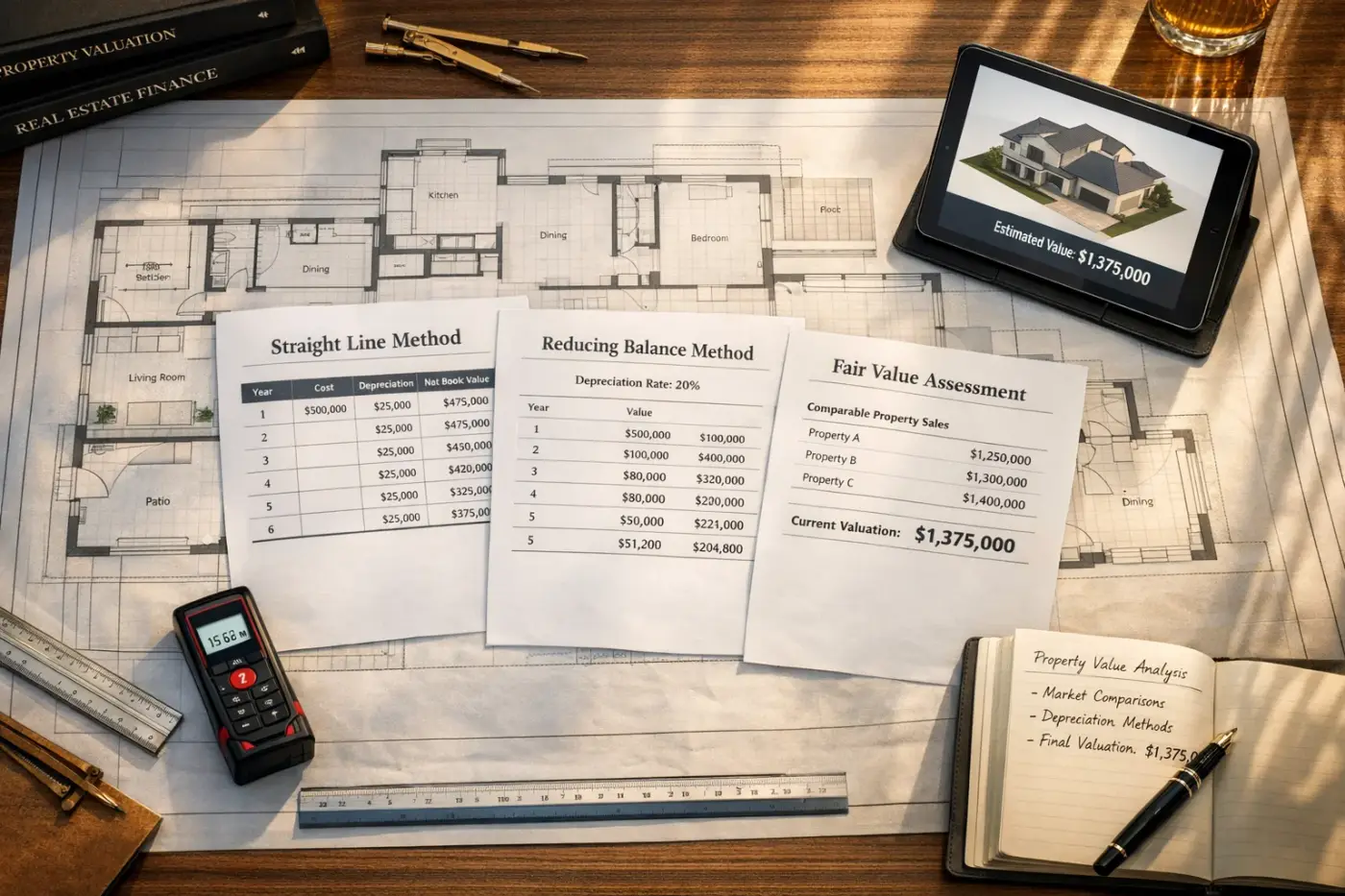
Following the acquisition of lateral property, you will need to choose a way to report on that value. Depreciation is where the value of buildings and improvements is amortised over their useful life, with a portion of the overall amount debited to P&L each year.
Straight-line depreciation divides the cost (less salvage value) evenly over the years. Land only appreciates; it is a stagnant asset.
Fair value measurement adjusts the values of assets to reflect their current market prices. That’s what your places are worth now, but you need to get them revalued regularly.
Best Practices, Technology, and Compliance in Property Accounting
Property Management Software and Automation
Property management software changes the game for daily financial tasks. These platforms combine accounting, tenant management, and maintenance scheduling in one place.
Automated rent collection means you don’t have to chase payments. The system sends reminders, processes transactions, and updates your books without you lifting a finger.
Look for features like:
- Bank feed integration for automatic matching
- Receipt scanning with OCR
- Customisable financial reports
- Multi-property management tools
Software like Buildium (and similar options) offer property-specific features that standard accounting tools just don’t.
Property Valuation and Depreciation Methods
(For Illustrative Purposes Only)
Meaning, good property valuation is one of the most important things you can do in your records for accounting.
Used for recording properties at purchase price and including capital improvements that extend asset lifespan
Under UK GAAP / FRS 102, commercial and residential investment properties are held at fair value and are not depreciated each year; instead, changes in market value are revalued across the balance sheet and profit/loss accounts.
However, capital allowances can apply to plant and machinery (such as commercial heating or air conditioning systems), and qualifying commercial buildings may claim the Structures and Buildings Allowance (SBA) over 33.3 years.
Property Accounting for Investment Property
Accounting for investment property is not subject to the same rules as director-occupied property. Record all income and expenses related to each property in your portfolio.
Income from rental isn’t just the monthly rent – factor in parking, laundry, and pet deposits. So put the money in your books; you earned it, even if they haven’t paid you.
With this method of accrual, you have a more accurate idea of your finances. Exercise caution in what you consider maintenance expenses.
Repairs (revenue expenses) help keep the property operational and provide an immediate deduction from taxable income. Note: Replacing older materials with modern equivalents (such as replacing single-glazed windows with double glazing) is generally treated as a revenue repair for tax purposes, not a capital improvement.
Essential tracking requirements:
- Profit and loss statements for each property
- Cash flow forecasts that reflect rental payment patterns
- Vacancy rates and their impact
- Reserve funds for big repairs
Stay on top of HMRC regulations to avoid penalties and make sure your tax reporting is spot-on.
Compliance, Taxation, and Financial Integrity

(For Illustrative Purposes Only)
Stay on top of HMRC regulations to avoid penalties and make sure your tax reporting is spot-on.
Making Tax Digital (MTD) means you need digital records and quarterly updates. Keep all property transaction records for at least six years.
This means invoices, receipts, bank statements, and tenancy agreements.
Digital records make audits a lot less stressful.
Scottish Property Tax Note: If you are acquiring investment properties in Scotland, remember to account for Land and Buildings Transaction Tax (LBTT) and the 6% Additional Dwelling Supplement (ADS) on your balance sheet as part of your total capital acquisition costs, as these replace English Stamp Duty (SDLT).
Tax deductions you can claim:
- Finance costs (Limited companies can deduct mortgage interest; individual landlords receive a 20% tax credit instead)
- Property insurance
- Maintenance and repairs
- Professional fees (accountants, solicitors)
- Letting agent fees
Frequently Asked Questions
What does property accounting involve in a real estate context?
It means tracking all money in and out for your properties, rent, expenses, improvements, and tenant charges.
How does property accounting work in practice for landlords and managing agents?
You set up separate accounts for each property, record rent and expenses, and use software to automate reports and reminders.
How are rental income, service charges, and arrears recorded and reconciled?
Record rent when earned, estimate and bill service charges, and track arrears in your accounts receivable system.
What is the difference between capital expenditure and revenue expenditure for property assets?
Capital expenditure improves or extends the property (added to your balance sheet and offset against Capital Gains Tax upon sale), whereas revenue expenditure covers routine repairs and maintenance (deducted directly from rental profit). Note that replacing old materials with modern standard equivalents (such as swapping single glazing for double glazing) is accepted by HMRC as a revenue repair rather than a capital improvement.
How is depreciation and asset valuation treated for buildings, plant, and equipment in accounts?
In UK property accounting, buildings usually don’t depreciate because they often retain or even increase in value over time.
But plant and equipment inside commercial properties do lose value as they age and wear out.
Think of plant and equipment as things like lifts, air conditioning, and heating systems.
You write off these items over their useful life, maybe 10 to 25 years, depending on what it is.