There are two common types you’ll see:
Private company limited by shares (Ltd): Owners (shareholders) buy shares and get dividends. This is the usual choice for small and medium businesses.
Company limited by guarantee: Used by non-profits and clubs. Members guarantee a set amount instead of holding shares.
You need to register your company with Companies House, appoint at least one director, and file annual accounts and a confirmation statement.
The share structure, Articles of Association, and any Shareholders’ Agreement specify how the company allocates decision-making and profit-sharing.
Understanding the Limited Company Structure

(For Illustrative Purposes Only)
Co Ltd Meaning and Legal Identity
When a business name has a “Co. Ltd”, “Ltd”, or “Limited” suffix, this indicates the business is a limited company. This means the business is a separate legal entity, and the owners’ potential financial losses are limited.
Such a company is legally separate from the directors and shareholders that constitute the business. In most cases, a director limits their personal liability to the amount they invested or guaranteed.
However, directors have legal responsibilities under the Companies Act 2006, including a duty of care to act in the best interests of the company and a duty to keep records for the company.
In casual conversation, people often refer to a limited company as a corporation, but in the context of UK law, “corporation” is a broader term.
An Ltd company is usually a private business as opposed to a public limited company (PLC), which has the ability to offer its shares to the public and has a higher level of regulatory scrutiny.
Features of Limited Companies
Some key features stand out:
Limited liability: Shareholders only risk their investment or guarantee amount.
Separate legal entity: The company, not the owners, holds assets and debts.
Ownership and control: Shareholders own the company; directors run it day to day.
Tax and reporting: Companies pay Corporation Tax and have to submit statutory accounts and company tax returns.
Share structure: You can create different share classes with different rights, like voting or dividends.
Transferability: Shares in a private Ltd are usually transferable, but the Articles or shareholder agreements may restrict this.
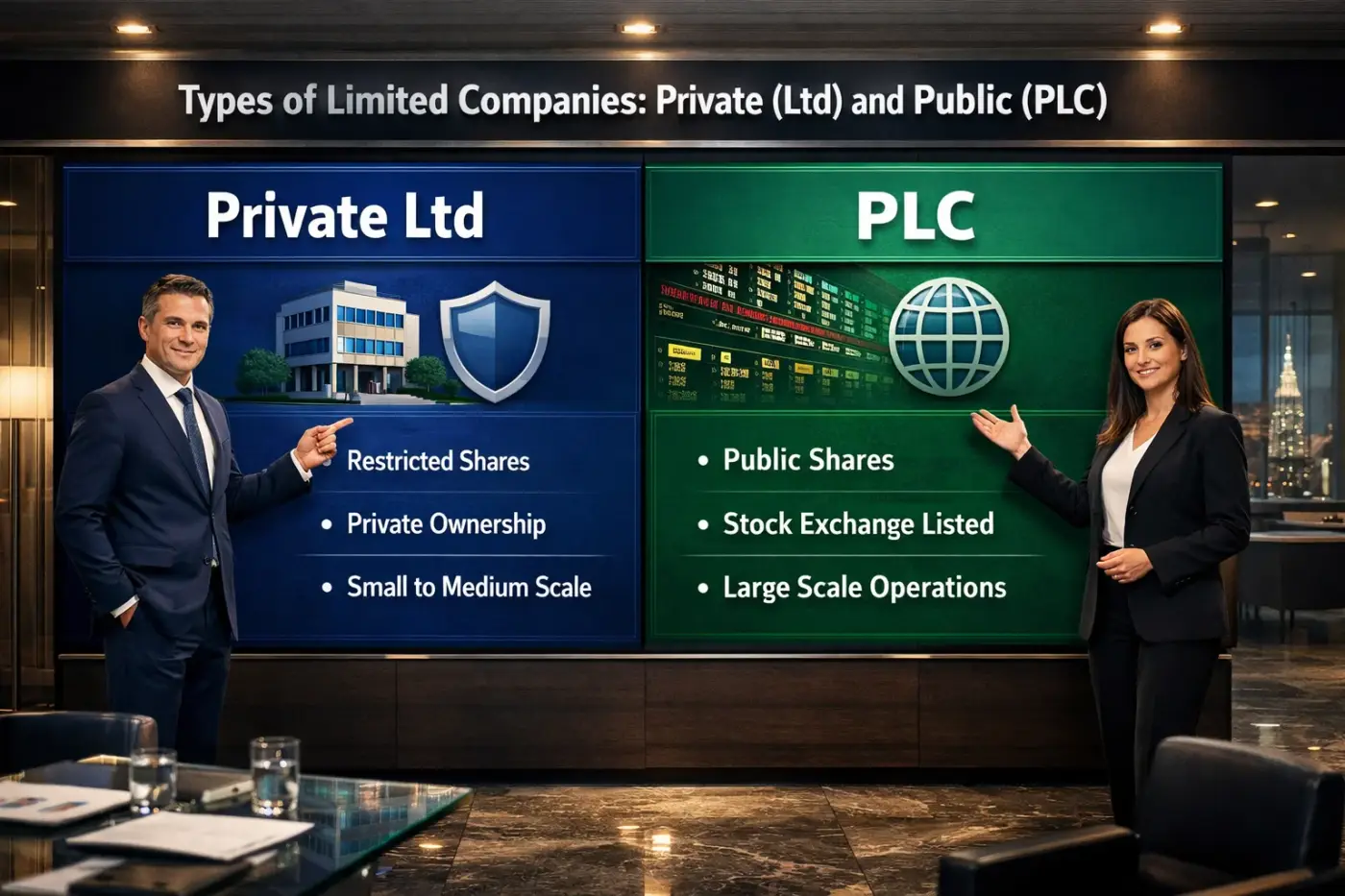
Types of Limited Companies: Private (Ltd) and Public (PLC)
(For Illustrative Purposes Only)
Limited companies are primarily divided into two main types, each with distinct characteristics, regulations, and purposes:
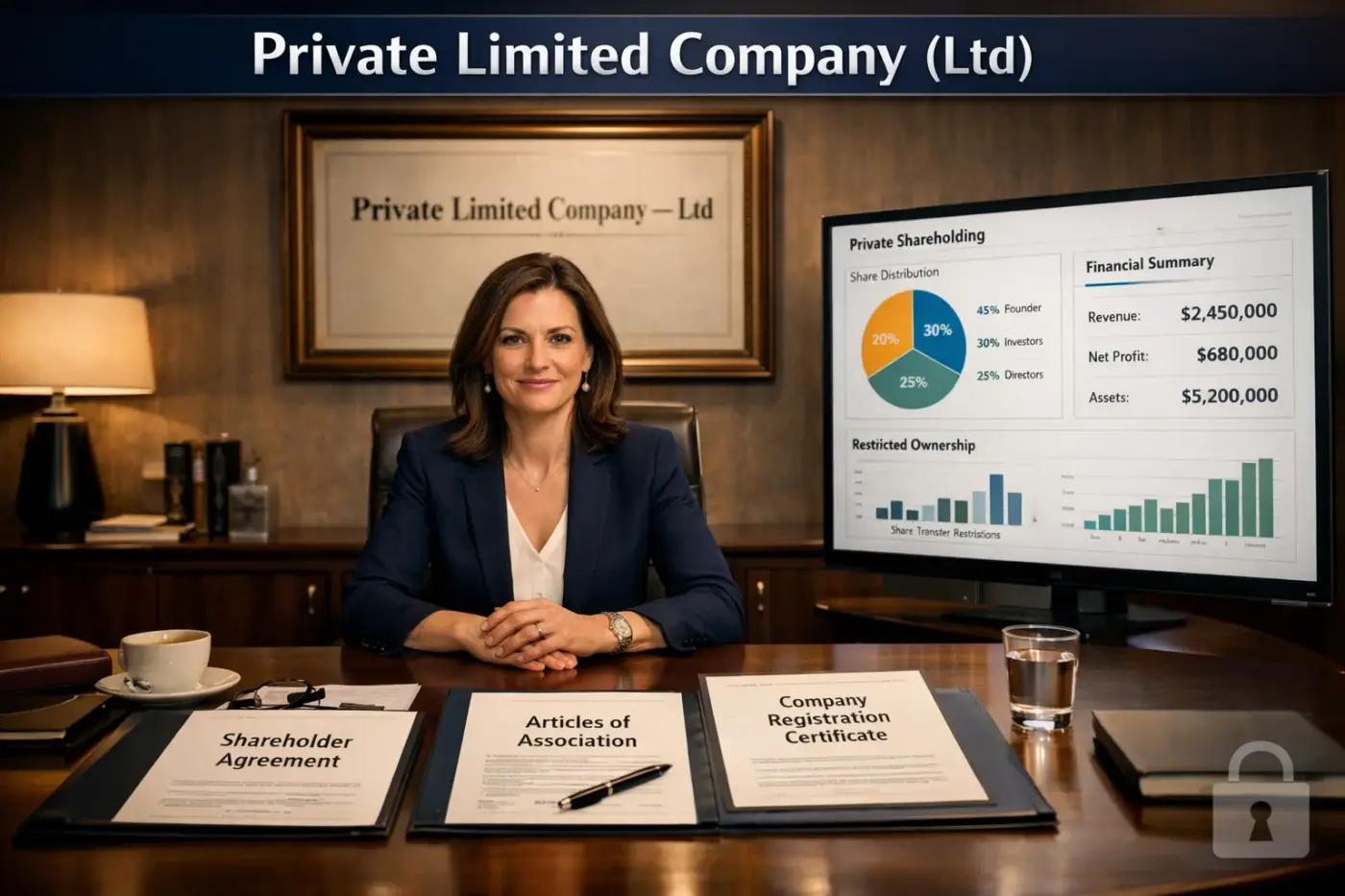
Private Limited Company (Ltd)
(For Illustrative Purposes Only)
Key Characteristics
- Ownership: Shares are privately held and cannot be offered to the general public
- Share Transfer: Shares can only be transferred with the consent of other shareholders
- Number of Shareholders: Minimum 1 shareholder; no maximum limit
- Public Disclosure: Limited financial disclosure requirements; accounts filed with Companies House but not publicly advertised
- Capital Requirements: No minimum share capital requirement (in most jurisdictions)
- Directors: Minimum 1 director required
- Accountability: Primarily accountable to shareholders
Advantages
- Privacy and confidentiality of financial information
- Flexibility in management and operations
- Limited administrative burden
- Lower compliance costs
- Easier to maintain control among founding members
Challenges
- Mandatory annual filing requirements with Companies House
- Limited access to capital compared to public companies
- Share ownership transfer limitations require consent from other shareholders
- Formal governance structures required
- Financial accounts filed at Companies House and publicly accessible
- Complex winding-up procedures if closure is needed
- Payroll and tax administration (PAYE, National Insurance)
Common Uses
- Small to medium-sized businesses
- Family businesses
- Professional practices (accountancy, legal firms, etc.)
Public Limited Company (PLC)

(For Illustrative Purposes Only)
Key Characteristics
- Ownership: Shares can be freely bought and sold by the public
- Stock Exchange: Can be listed on a stock exchange
- Number of Shareholders: Minimum 2 shareholders; typically thousands
- Public Disclosure: Extensive financial disclosures required; regular public reporting
- Capital Requirements: Minimum share capital requirement (varies by jurisdiction)
- Directors: Minimum 2 directors required
- Accountability: Accountable to shareholders and regulatory authorities
Advantages
- Access to capital markets for fundraising
- Enhanced credibility and prestige
- Liquidity for shareholders
- Greater ability to acquire other companies
- Potential for significant growth
Want to read the full advantages and disadvantages?
Read HereChallenges
- Extensive regulatory compliance
- High administrative and legal costs
- Public scrutiny of finances and operations
- Less privacy and confidentiality
- Risk of hostile takeovers
Common Uses
- Large corporations
- Companies seeking to raise capital from the public
- Established businesses ready for public markets
| Aspect | Private Ltd | Public PLC |
|---|---|---|
| Share Trading | Restricted | Publicly traded |
| Capital Raising | Limited to private investors | Stock exchange and public |
| Financial Reporting | Less stringent | Highly regulated |
| Shareholders | Fewer known parties | Many, often unknown |
| Compliance | Lower | Extensive |
| Disclosure | Private | Public |
Some Other Types Of Limited Company

(For Illustrative Purposes Only)
Company Limited by Shares
A company limited by shares will sell its shares to its owners. As a shareholder, your liability ceases to exist for any unpaid amount on your shares.
Should the company go bankrupt, your only loss will be the investment you made in your shares. This is how private limited companies (Ltd) usually function.
You cannot offer your shares to the general public, nor can you list your company on a stock exchange.
Usually, the company’s articles of incorporation contain provisions on the transfer of shares so that the directors and selected investors retain control.
Companies that are public limited (PLC) are also limited by shares, but they must comply with stricter capital and disclosure requirements to offer their shares to the public.
Company Limited by Guarantee
A company limited by guarantee has no shareholders, but members must agree to pay a predetermined sum if the company winds up.
This guarantee is usually a nominal sum, so members’ risk is minimal. This structure is most often used in charities, clubs, and non-profits.
Members do not receive shares, and any profits are usually reinvested to further the company’s purpose.
Members do, however, get governance rights such as voting at general meetings and the right to appoint directors. This model is appropriate if your structure is purpose-driven and you do not wish to raise capital by issuing shares.
Key Characteristics, Finances, and Practical Considerations
Limited Company Finances and Taxation
A limited company must pay Corporation Tax on profits made. You must prepare annual accounts and submit them to Companies House, as well as prepare and submit a Company Tax Return to HMRC.
As a director or shareholder, your remuneration is via salary, dividends, or a mixture of both, which also determines the level of tax exposure to you and your company. Being organised will pay off, maintain good records and ledgers, file VAT returns if you cross the threshold, and submit PAYE returns for your employees.
If the company is making a loss, you cannot pay dividends. Dividends are paid out of post-tax profits. There is a lower risk of non-compliance if you use accounting software or, better still, engage an accountant to assist. They will also help to design a tax-efficient remuneration plan.
Ownership, Shares, and Corporate Governance
Control in an Ltd is defined by share ownership. At general meetings, shareholders can exercise their economic rights by electing or dismissing directors.
Voting, meetings, share transfer, and decision-making regulations are defined by your company’s Articles of Association. While shareholders are investors, directors are responsible for managing the company.
You have the flexibility to create share classes for various investors, as well as voting, non-voting, or preference shares. To regulate share transfers and decisions, private limited companies typically employ shareholder agreements.
Comparing the Limited Company with Other Business Structures
Selecting a Limited company (Ltd), sole trader, or partnership can impact the level of risks, the tax implications, and how much paperwork you have to deal with. As a sole trader, you get to keep all the profits but have unlimited personal liability.
A partnership can be simple to manage, but there is likely a joint liability with the other partners. An Ltd is good for personal liability and separating personal and business finances, giving you limited liability.
An Ltd has fewer regulatory requirements than a Public Limited Company (PLC) and also loses the ability to offer shares to the public. This makes an Ltd a good option for small businesses and startups.
Frequently Asked Questions
What does “Ltd” stand for in a company name?
“Ltd” stands for “Limited”.
It means the company has limited liability for its owners.
How does a limited company work in practice?
A limited company is legally separate from its owners.
It signs contracts, owns stuff, and pays tax in its own name.
Directors run the daily business and follow company rules and the Companies Act.
Profits can come as salaries or dividends, and the company files annual accounts and a confirmation statement with Companies House.
Who holds ownership and who holds control of a limited company?
Since ownership is determined by shareholding, a limited company is owned by shareholders who can be independent individuals or be structured as corporate entities. On the other hand, company control is given to Directors who handle the day-to-day running of the company and its legal compliance.
Significant company governance changes are made through voting by shareholders. This can include the appointment of new directors or the modification of the articles of association.
What are the most outstanding benefits of conducting business as a limited liability company?
Firstly, a limited liability company offers the owner a liability safety net that protects personal assets from the company’s debts, with liability limited to the owner’s investment in the company.
Secondly, company directors can minimise the tax implications on their income through a combination of salary and dividends. Finally, a limited liability company is more attractive to banks, investors, and suppliers.
What are the main disadvantages of operating as a limited company?
You have to file annual accounts and other documents with Companies House and HMRC.
That adds admin, record-keeping, and some public disclosure.
Directors have legal duties and could face personal liability for breaches.
Running payroll, corporation tax, and dividends is a bit more involved than being a sole trader.